Tuesday, July 02, 2013

The rocky road of defending civil liberties in Harrisburg
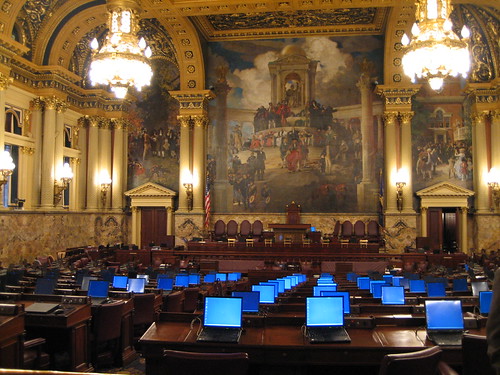
"Later, y'all! Y'inz! You guys!"

The last trickle of activity in the spring session of the Pennsylvania General Assembly carries on tomorrow, as the state Senate finishes some budget-related matters. The state House has already left town. And there's no truth to the rumor that they were run out of town on a rail. That's not even possible since they didn't invest anything in rail.

In the final weeks of June, all was largely quiet on the civil liberties front at the state capitol. That's a good thing. When the legislature starts screwing with civil liberties, it usually ends badly.

And it did end badly for women's access to reproductive healthcare. On June 17, Governor Corbett signed House Bill 818. This bill prohibits insurance companies from covering abortion care in policies in the insurance exchange, or marketplace, created by the federal healthcare reform law. Narrow exceptions exist only for rape, incest, and imminent death of the woman.

I've been trying to decide which is the most scandalous aspect of this story. Is it the state government meddling in a private transaction between a private company and a private customer, under the flimsy excuse that the exchange is administered by the government? (The federal government, mind you. The Corbett administration opted out of administering the exchange at the state level.) The supporters lamely claim that insurance coverage from Blue Cross is equivalent to Medicaid.

Is it the lack of a health exception that the Senate defeated, 24-26? Some women have serious complications in pregnancy that can lead to health problems but not death and that are best avoided via abortion. If a woman faces that crisis and has insurance through the exchange, sorry, she has to pay out of pocket. Here is how that vote went down.

Or is it the inability of the General Assembly to pass an infrastructure investment and repair bill (author's note: not a civil liberties issue) while finding the time to restrict women's access to comprehensive reproductive healthcare? Hey, a bridge might collapse, but at least they found time to restrict abortion!

Here at ACLU-PA HQ, Harrisburg, we're gearing up for summer work with legislators and staff on revising the child protective services law and revisions to the Right to Know law.

And here's something to look forward to in the fall: A storm is brewing over privacy and mass data collection, specifically in legislation to collect DNA from people who have not been convicted of a crime and to create a new database of Pennsylvanians' prescription drug use. These are issues where ACLU-PA gets to flex its nonpartisan cred by working with Republicans and Democrats who recognize that we do not want to go down the road of a Total Information Society.

So our legislators are (almost) out of here for the summer. They can enjoy their recess with the knowledge that their constituents will think of them everytime they bounce off a pothole in the middle of state route (fill in the blank). And we can rest assured that civil liberties are safe for the next two months. See you in September....

Labels: , , , , , , ,

Monday, June 03, 2013

Top 5 Reasons Pennsylvania May Not be the next DNA collection State

Today's Supreme Court decision that upheld Maryland's preconviction DNA collection law was pretty much atrocious, as pointed out earlier by my colleague Ngani. But there's no guarantee that Pennsylvania will be next. Here's why, from the home office in Harrisburg, Pennsylvania.

5. Last year the state Senate passed a preconviction DNA bill. It was rejected by the state House. In October, the House passed an amendment by a freshman Democrat, Representative Brandon Neuman of Washington County, that gutted the bill, including the DNA collection provision with 132 votes in favor of the amendment. This bipartisan coalition included the Speaker of the House.

4. The public safety arguments fall flat. In 2011, Maryland collected 11,000 DNA samples from people charged but not yet convicted of a crime under its law. That led to nine additional convictions for unsolved crimes. Not 90. Not 900. Not 9,999. But nine. Plus, under the commonwealth's current, postconviction DNA law, the Pennsylvania State Police (PSP) has a backlog of eight months to test DNA samples, a backlog that will only balloon if the legislature passes a preconviction collection bill. No one can argue with a straight face that preconviction DNA collection protects public safety.

3. It's expensive. PSP has estimated that preconviction DNA collection would cost $13 million.

2. The right to privacy under the state constitution is robust. Pennsylvania courts have consistently ruled that Article I, Section VIII of the state constitution provides greater privacy protections in search-and-seizures than the Fourth Amendment of the federal constitution.

1. The ACLU of Pennsylvania is on it. And we're awesome.

Labels: , , ,

Monday, October 29, 2012

State legislature, governor re-victimize victims: Part Two

The new sexting law is not the only way in which the General Assembly and Governor Corbett have harmed victims recently. They also managed to pass a new law that does nothing for victims of sexual assault while ratcheting up the hysteria over HIV-AIDS.

House Bill 1794, now Act 201 of 2012, passed the legislature two weeks ago and was signed by the governor on Thursday. This new law allows a district attorney to seek and a judge to order a forced HIV test of a person arrested for sexual assault. (The ACLU of PA supports universal HIV testing but opposes forced testing of anyone.) The DA must seek the order in consultation with the victim.

That sounds great on its face. Right, only to people who know nothing about HIV. The Centers for Disease Control and Prevention has a recommended protocol for people who may have been exposed to HIV. It involves a regimen of drugs known as post-exposure prophylaxis, or PEP. PEP reduces the chances that a person will contract HIV after possible exposure.

This drug regimen must be started within 72 hours of the exposure. Ideally, it is started within 2-36 hours. What are the chances that a suspect is arrested, the DA consults with the victim, the DA seeks the order, a judge issues the order, an HIV test is administered on the arrestee, and the results are returned within 72 hours? Slim to none.

This new law is also based on the false idea that everyone who is arrested must be guilty. Google "innocence project" and you'll know that's not true. According to the Innocence Project, "there have been tens of thousands of cases where prime suspects were identified and pursued—until DNA testing (prior to conviction) proved that they were wrongly accused."

Imagine this nightmare scenario. The DA has arrested the wrong person, and he's HIV positive. What kind of additional trauma will that place on the victim? Or imagine that they've arrested the wrong person and he's HIV negative, giving the victim a false sense of security.

People with HIV can also test negative. In the first six weeks to six months that a person has contracted the disease, he or she tests negative. This is also the time in which the person is most likely to transmit the disease because his viral load is high.

There is another factor here, a fact that is little discussed. Transmission of HIV is relatively rare. According to one study, a person with HIV will transmit the disease to a partner once in every 900 unprotected sexual encounters. According to the CDC, transmission by consensual vaginal intercourse is 0.1%-0.2% and by consensual anal intercourse is 0.5%-3%. (Transmission rates by sexual assault are not known.)

Of course, safe sex is extremely important to slow the spread of HIV. But this new law is based on the false idea that exposure equals transmission. It does not. 

According to a 2009 survey by the Kaiser Family Foundation, 51 percent of people would be uncomfortable having their food prepared by someone who is HIV positive. This law is based on the same wrong-headed attitude toward HIV. It furthers the hysteria around HIV, and that leads to those living with the disease to be further ostracized and isolated.

Sexual assault victims need the best care possible, and that care comes from medical professionals, not DAs or judges.

Learn more about the ACLU's work on HIV-AIDS by visiting the webpage of our AIDS Project.

Labels: , , ,

State legislature, governor re-victimize victims: Part One

For all of the rhetoric around crime victims' rights at the General Assembly, it's hard to believe that any legislation that harms victims could ever be passed. But that's exactly what happened two weeks ago. And it happened twice.

Two weeks ago, the legislature passed House Bill 815, and the governor signed it on Thursday, now Act 198 of 2012. This bill creates a new crime of teen "sexting." You're probably familiar with sexting by now, but if not, it is a term used to describe a wide range of activity that involves photos, sex, and electronic communication. Basketball fans, think Greg Oden.

Act 198 creates summary and misdemeanor offenses that involve sexting by kids between the ages of 13 and 17. The charge is based on the circumstances of the activity.

Imagine this scenario. Two 17-year-olds are dating and send pictures of themselves in various stages of undress. Newsflash: Teens are clumsy with their sexuality. Teens have been exploring their sexuality since our species evolved and don't always do it in a mature way. That's not exactly earth-shattering news.

So she dumps him. In anger, he sends her semi-nude photo to the entire school. She's a victim of abuse, right? Well, under Act 198, she's a criminal because she produced the photo and sent it to her then-boyfriend. She could be charged with a summary offense.

There have been some tragic incidents that have involved teens sexting. And the supporters of HB 815, including the Pennsylvania District Attorneys Association, have used these incidents to push for this bill. The DAs used these incidents in which kids were abused to push for a bill- now law- that will criminalize these victims, which will only compound their suffering. Incredibly, some so-called victims' advocacy groups supported the bill, too.

Supporters of HB 815 claim that all sexting by teens (under the age of 18) is currently felony child pornography, even if the person in the photo also produced it. The DAs think that if they say something is a crime, then it's a crime. 

They fail to respect the role of the judge in our judicial system. Not a single court in Pennsylvania has upheld a felony charge in a sexting situation. Not one.

So, parents, make sure that sexting is part of The Talk with your kids. And in Pennsylvania, be sure that they understand that sexting, even if it's consensual, could lead to a visit from their local DA, who apparently is more concerned about what teens do in their bedrooms than he is about real criminals.

A second post is coming about how the legislature and the governor harmed victims with ill-advised legislation.

Labels: , , , ,

Thursday, June 07, 2012

The Inside Game: On getting seven bills passed in one session

In the lobbying game, any association or organization or legislator that could get seven bills passed in one session would be ecstatic. I've been doing this lobbying thing for five years and have been hanging around the capitol as an activist for 12 years, and I can't think of anyone getting that kind of return in one session.

The supporters of HB 2400, the spying bill that loosens the state Wiretap Act, could get seven provisions that they want right now. HB 2400 revises the act in approximately 13 different ways. The ACLU of Pennsylvania has no position on seven of those changes, and we are not aware of any opposition to those seven revisions.

But that's not enough for the government officials who insist on gathering more power for themselves. They want more. And that's where the resistance begins. They want de facto repeal of Pennsylvania's "two party consent" rule that requires all parties in a private conversation to consent to recording with the following changes:
  • Recording without consent if notice of possible recording has been posted. Somewhere.
  • Recording without consent if the person thinks that maybe, possibly, they'll gather evidence of a past, present, or future crime
  • Allowing the government to use recordings that civilians have made illegally
  • Admitting wiretaps from other states or the federal government, even if that jurisdiction doesn't have the same privacy standards as Pennsylvania, i.e. two party consent versus one party consent
They also want to be able to seize mobile phones and then intercept incoming messages and send outgoing messages from those phones without ever telling a court what they're doing. And they want to be able to gather mobile location data from cell phone companies- both historical and in real time- with a loose "relevant to an investigation" standard.

This is why it is so important for Pennsylvanians to watch their government and why it is so important that the ACLU exists. Our founders understood that power in human hands must be checked. That's why we have three branches of government and why the first ten amendments to the constitution limit the powers of government. 

The supporters of HB 2400 could wave the flag of victory with seven revisions to law and walk away. But they insist on pushing for more. They must be stopped.

Labels: , , , , ,

Tuesday, June 05, 2012

Noxious Creeping Part V: PA legislators to other states- "Please decide our laws for us"


“(T)he erosion of freedom rarely comes as an all-out frontal assault but rather as a gradual, noxious creeping, cloaked in secrecy, and glossed over by reassurances of greater security.” – Senator Robert Byrd

A group of prosecutors in Pennsylvania is seeking a major expansion of government surveillance power.  They are advocating for House Bill 2400, and we expect its supporters to try to fast-track the bill through the legislature before it can get a thorough review from lawmakers and the public. The bill would make about a dozen changes to current law, many of which seriously undermine Pennsylvanians’ privacy. We’re discussing the worst of them in a series of posts. This post discusses a proposal to allow Pennsylvania courts to consider wiretaps that were legally made under other states laws, even if they would have been illegal in Pennsylvania.

Part V: PA Legislators to other states—“Please decide our laws for us”

HB 2400 would require Pennsylvania courts to consider recordings that were legally made in jurisdictions other than Pennsylvania. For example, if a person legally recorded another in New Jersey, a Pennsylvania court would have to accept the recording as evidence. The Pennsylvania court would have to allow the recording, even if the recording would have been illegal if it had been made here.

Pennsylvania has a tradition of granting broader privacy rights than many other states. Even the United States Constitution offers less protection for personal privacy than does Pennsylvania law. Our state constitution’s guarantee against unreasonable searches is older than the Fourth Amendment in the Bill of Rights. In our wiretap statutes, Pennsylvania long ago decided that all parties to a conversation must consent to recording. In contrast, many states require only one party to consent. Our commonwealth’s robust privacy protections make a strong statement: We helped give birth to American liberty, and we want to enjoy as much of it as we can.

Unfortunately HB 2400 would contradict our tradition of assuring strong privacy rights. The bill would force Pennsylvania’s judges to open their courtrooms to recordings that would be illegal and inadmissible if they had been made here. The all party consent rule—a fundamental protection for all who appear in Pennsylvania’s courts—could disappear for some defendants.  Admissibility would depend merely on where their conversations were intercepted. The legislators of other states, as well as members of Congress, would have the authority to decide when Pennsylvania courts would have to admit certain recordings.

Our legislators in Harrisburg can talk a good game about states’ rights and Pennsylvania’s authority to govern itself. But when it is time to step up to the plate, do their votes follow their rhetoric? The supporters of HB 2400 must be hoping the answer is “No.”

Nathan Vogel, Frankel Legislative Fellow, ACLU of PA

Labels: , , , , ,

Monday, June 04, 2012

Noxious Creeping Part IV: By reading this, you've consented to audio surveillance


“(T)he erosion of freedom rarely comes as an all-out frontal assault but rather as a gradual, noxious creeping, cloaked in secrecy, and glossed over by reassurances of greater security.” – Senator Robert Byrd

A group of prosecutors in Pennsylvania is seeking a major expansion of government surveillance power.  They are advocating for House Bill 2400, and we expect its supporters to try to fast-track the bill through the legislature before it can get a thorough review from lawmakers and the public. The bill would make about a dozen changes to current law, many of which seriously undermine Pennsylvanians’ privacy. We’re discussing the worst of them in a series of posts. This post discusses a proposal to add a notice exception to the definition of “oral communications.” The new exception would allow anyone who gives notice of surveillance to record otherwise private conversations.

Part IV: By reading this blog post, you have consented to audio surveillance.

One of the most far-reaching proposals of HB 2400 creates a “notice exception” to the definition of oral communications.  Currently, the wiretap law bans recording most private oral communications. HB 2400 proposes a new rule that an oral communication isn’t private if the speaker has notice that it might be recorded.  In other words, as long as someone has notified you that surveillance may happen, you have no right to expect that your conversation is private.

This includes “actual notice,” which means you actually are aware that you may be recorded. It also includes “constructive notice.” That’s a jargony term meaning, “it’s written down on something that you were supposed to read.” Like a sign in the front office of a building, or in the back of the employee handbook. If HB 2400 passes, we can expect to see “you may be under surveillance” signs popping up all over. And you can expect to be under surveillance whenever you are not at home, whether you are out in public or not.

The notice exception makes it easy for anyone to remove any expectation of privacy in public and private space. Let’s consider a couple examples. An employer could post a sign about audio surveillance in the front office or in an employee handbook. Then the employees’ private conversations could be recorded in elevators, offices, shop floors, and lunch rooms. Don’t criticize the boss, and don’t talk about unionizing at work. 

The exception would apply in schools as well. The meetings of student groups such as the Gay-Straight Alliance might be recorded. Or administrators might decide to listen in on school newspaper meetings or student government meetings to make sure no one criticizes school policies.
             
Instead of the notice exception, the ACLU of Pennsylvania supports a different definition of “oral communications” that protects privacy rights. We ask the legislature to define “oral communications” as, “Any oral communication uttered by a person possessing a reasonable expectation of privacy in such communications.” Our proposal clarifies the current law rather than changing it significantly. Since 1998, Pennsylvania Courts have interpreted “oral communications” to cover only situations where the parties to a conversation had a reasonable expectation of privacy. See Agnew v. Dupler, 553 Pa. 33 (Pa. 1998). Our proposal would rewrite the current statute to make it crystal clear that a person’s “reasonable expectation of privacy” should remain the cornerstone of privacy rights in the wiretap act.

The “reasonable expectation of privacy” rule protects privacy where HB 2400 would threaten it. Instead of looking only to whether someone posted notice somewhere, courts interpreting the “reasonable expectation of privacy” rule look to all the circumstances surrounding a conversation. So even if the front office had a sign about audio recording, students might still be able to have a private conversation in a closed classroom, or employees might still be able to speak in an otherwise empty elevator without the boss listening. 

All of us—whether as employees, students, or in some other role—should have the right to hold private conversations from time to time, even if we are not at home. HB 2400, as it is currently written, would make this right a rare one. 

Nathan Vogel, Frankel Legislative Fellow, ACLU of PA

Labels: , , , , ,

Friday, June 01, 2012

Noxious Creeping Part III: You can record if you think they might admit to thinking about doing something bad in the future


“(T)he erosion of freedom rarely comes as an all-out frontal assault but rather as a gradual, noxious creeping, cloaked in secrecy, and glossed over by reassurances of greater security.” – Senator Robert Byrd

A group of prosecutors in Pennsylvania is seeking a major expansion of government surveillance power.  They are advocating for House Bill 2400, and we expect its supporters to try to fast-track the bill through the legislature before the state budget passes, which is due at the end of June, and before it can get a thorough review from lawmakers and the public. The bill would make about a dozen changes to current law, many of which seriously undermine Pennsylvanians’ privacy. We’re discussing the worst of them in a series of posts. This post discusses the proposal to allow anyone to record private conversations if they believe they will capture evidence of a crime of violence or first degree felony.

Part III: The Evidence Exception, or You can record if you think they might admit to thinking about doing something bad in the future.

Pennsylvania’s wiretap law requires that everyone in a private conversation consent before anyone can record it. The law protects everyone’s privacy by making sure that everyone has a chance to keep a private conversation private.

Legislators are proposing to create a new exception that punches a massive hole in the “all-party consent” rule—a hole with ragged, unraveling edges. This “Evidence Exception” would allow any person to record anything if they have a reasonable belief the recording will capture evidence of a past, present, or future crime. For now, at least, the exception is limited to “crimes of violence” and first degree felonies.

On its face, the law would give individuals permission to secretly record each other in many private conversations. For example, one person’s malice towards another can be good evidence in an assault case. Under this law, a person might record another person badmouthing a third person, just in case the third person was ever the victim of a violent crime sometime in the future.

The proposed law also puts a confusing burden on civilians to decide when the exception actually applies. You would only be allowed to record if you thought you would find evidence of a “crime of violence” or a first degree felony. Otherwise recording without consent is still a crime. Quiz: Sometimes burglary is a first degree felony and sometimes it is not; and sometimes it is a crime of violence and sometimes it is not. Do you know the difference?[1] How many people will be able to say whether the proposed law would allow them to record a private conversation or not? Not many, I suspect, without seeking advice from a lawyer first.

If this proposed exception seems broad by itself, consider also that it would be very likely to expand. Once we allow recording to capture evidence of “crimes of violence” and felonies of the first degree, preventing the exception from sweeping in other offenses as well will be almost impossible. Discharging a firearm into an occupied structure is pretty awful, but it is only a felony of the third degree. 18 Pa.C.S. 2707.1(b). If a legislator in the future votes against expanding the Evidence Exception to include that offense, is he or she supporting discharging firearms into occupied structures? Casting votes to keep the exception where it is would be politically very, very difficult. Inevitably, some legislator or some prosecutor will cite an emotional case to justify further expansion of this exception.

As it is now, the Evidence Exception is so large it could nearly swallow all-party consent by itself. And once created, it could easily grow even larger.
Instead, we should keep it off of Pennsylvania’s law-books entirely.


[1] Does it help if I tell you that burglary is only a second degree felony “If the building, structure or portion entered is not adapted for overnight accommodation and if no individual is present at the time of entry”? 18 Pa.C.S. 3502. The definitions of “crimes of violence” are at 42 Pa.C.S. 9714(g).

Labels: , , , ,

Thursday, May 31, 2012

Noxious Creeping: Amending the PA Wiretap Act (Part II)


“(T)he erosion of freedom rarely comes as an all-out frontal assault but rather as a gradual, noxious creeping, cloaked in secrecy, and glossed over by reassurances of greater security.” – Senator Robert Byrd

A group of prosecutors in Pennsylvania is seeking a major expansion of government surveillance power.  They are advocating for House Bill 2400, and we expect its supporters to try to fast-track the bill through the legislature before the state budget passes and before it can get a thorough review from lawmakers and the public. The bill would make about a dozen changes to current law, many of which seriously undermine Pennsylvanians’ privacy. We’re discussing the worst of them in a series of posts. This post discusses the proposal to kill the rule that prevents prosecutors from using civilians’ illegally- made wiretaps in court.

Part II: Allowing prosecutors to use illegal civilian wiretaps
In Pennsylvania, it is a crime to record the private conversations of another person without his consent. If someone commits this crime, prosecutors cannot use the illegal recording in court.

Excluding illegal civilian wiretaps from court is a common sense rule. It guarantees that a person cannot be convicted of a crime based on evidence that someone got by committing an illegal act against the person. The Fourth Amendment to the U.S. Constitution already requires that if police illegally wiretap a person, the illegal recording cannot be used against him in court. Prohibiting illegal civilian wiretaps is a logical extension of the Fourth Amendment rule.

Imagine if the rule did not exist: A person could intentionally commit a crime—recording private conversations without consent—against another.  If a prosecutor used an illegal wiretap in court, would the prosecutor be likely to turn around and prosecute the person who made the illegal recording? And is it too farfetched to imagine a law enforcement officer, with a wink and a nod, telling a complaining witness, “If I recorded the suspect’s conversation, we couldn’t use it in court. But if somebody else did it…”?

It shouldn’t surprise you that prosecutors want to get rid of this “exclusionary rule” for civilian illegal wiretaps.  But it should surprise you that some legislators appear to be considering it. If the supporters of HB 2400 succeed, any illegal wiretap could end up in court as evidence against the victim of illegal, secret surveillance.
Excluding illegal wiretaps—by police or civilians—is how the law ensures that privacy rights in constitutional and statutory law are more than just words on paper. It is a sensible rule, and it should stay in the laws of Pennsylvania.

Nathan Vogel, Frankel Legislative Fellow, ACLU of PA

Labels: , , , ,

Wednesday, May 30, 2012

Noxious Creeping: Amending the PA Wiretap Act (Part I)


“(T)he erosion of freedom rarely comes as an all-out frontal assault but rather as a gradual, noxious creeping, cloaked in secrecy, and glossed over by reassurances of greater security.” – Senator Robert Byrd

A group of prosecutors in Pennsylvania is seeking a major expansion of government surveillance power.  They are advocating for House Bill 2400, and we expect its supporters to try to fast-track the bill through the legislature before it can get a thorough review from lawmakers and the public. The bill would make about a dozen changes to current law, many of which seriously undermine Pennsylvanians’ privacy. We’re discussing the worst of them in a series of posts. In this post, I discuss the proposal to allow law enforcement to secretly intercept and send text messages using cell phones they obtain from civilians.

Part 1: Who is that text message really from?
Overturning Cruttenden
One of the changes they want would overturn the Pennsylvania Superior Court’s decision in Pennsylvania v. Cruttenden.  The case involved an informant who turned his cell phone over to police when he was caught with drugs in his car.  The police intercepted text messages from the informant’s alleged supplier and sent replies without revealing their identities. The supplier, thinking he was still talking to the informant, set up a meeting. But when he got there, instead of meeting the informant he was arrested and charged with criminal attempt, conspiracy, and other offenses.  On appeal, the Superior Court held that police violated the Wiretap Act when they failed to get a court order for using the cell phone. If police want to take a person’s cell phone, intercept text messages, and send text messages from the phone while pretending to be the intended recipient, they must get a court to say okay. 

Prosecutors want to pass a law to overturn the case.  They want to allow law enforcement to receive and send text messages on any phone that they “lawfully obtain.” They want law enforcement to be able to do this without any court oversight and without revealing their identities to the people they are communicating with.

Even if you think police should be allowed to use a phone that an informant voluntarily hands over for police to use, the proposed bill would go much farther. Police could intercept and send messages on any phone they “legally obtain.” This appears to allow police to seize the phones of people they arrest, and then use those phones to try to trick others into sending incriminating messages.  It even seems to create an incentive for law enforcement to arrest people in order to seize and use their phones. 
Prosecutors say that the court order requirement gets in the way of law enforcement.  That’s true. “Getting in the way of law enforcement” is also the purpose of the Fourth Amendment and much of the Wiretap Act.   It would be convenient for law enforcement to be able to read any text message anyone sends.  But we don’t want to live in a society where we are never sure if our private text messages will end up in a police dossier or if text messages we receive come from our friends or from the government.

Nathan Vogel, Frankel Legislative Fellow, ACLU of PA

Labels: , , , ,

Monday, May 14, 2012

A swab in the cheek while the State Police cracks

Today the Pennsylvania Senate Law and Justice Committee and the House Judiciary Committee held a joint hearing in Gap, Lancaster County, on the plans by the Pennsylvania State Police to close its barracks in Ephrata and to downgrade the status of Troop J, the local PSP headquarters, to a substation. The latter move would lead to numerous services of the state police moving elsewhere.

PSP Commissioner Frank Noonan testified and was followed by several local leaders. Noonan said that the state police is currently 435 troopers short of its full complement, statewide, and expects to be at 500 short by the time the next class of cadets graduates from the academy. The locals, including the chairman of the county commissioners, the district attorney, and the chief of police in the city of Lancaster, protested PSP's planned closure.

Could PSP use $13 million? That's Noonan's estimated cost of Senate Bill 775, a bill to collect DNA from people who have not been convicted of a crime but who have been arrested for a felony or one of several designated misdemeanors. We oppose this bill because taking a DNA sample from someone is a search, and in order to conduct this search, the government needs a finding of probable cause that it will produce evidence of a crime. The high state court in Maryland recently came to the same conclusion. DNA collection from people who have not been convicted of a crime turns innocent-until-proven-guilty on its head.

The pricetag isn't the only significant practical problem with this bill. PSP's DNA caseload will increase from 23,000 samples per year to 121,000 samples per year, according to an article published in the Philadelphia Inquirer in February. Under current law, in which DNA is taken from those convicted of a felony or one of the designated misdemeanors, it takes eight months to analyze a DNA sample. The wheels of justice could come to a grinding halt if SB 775 becomes law.

Incredibly, in this environment, the House Judiciary Committee is rumored to be taking up SB 775 before the end of June. While local leaders gnash their teeth over the closure of a nearby state police barracks and while PSP leaders decry their shortage of troopers, the legislature may take up this bill to place a new and expensive burden on the state police.

How many troopers could the state hire with $13 million?

Labels: , , ,

Friday, February 24, 2012

Yes, Virginia, there is a state more demeaning to women than you

A mock letter to the people of Virginia.

Dear Virginia, (CC: outraged left wing media)

Your little legislature was wrong. There is a state more demeaning to women than you. Up here across the Mason Dixon line, we’ve managed to come up with a forced ultrasound bill more cruel and medically unnecessary than yours! (It was tough, I’ll be honest.)

If our bill becomes law, women will have to wait at least 24 hours after their ultrasound before an abortion, no matter how far away they live from the provider. And here in Pennsylvania, 113 of the 203 elected state Representatives have signed on to our ultrasound bill. That’s more than your twelve by a long shot!

Our bill FORCES the doctor to turn the ultrasound screen towards the woman’s face. Don’t worry – we avoided constitutional meddling by “allowing her” to look away. I heard you only give ‘the opportunity’ to view the ultrasound image. LAME!

LOVE the “free ultrasound providers” bit! We did that, too, so now we can funnel women to those so-called “crisis pregnancy centers” where they can be fed state-funded, unregulated misinformation. We don’t even require that ultrasound providers have any training!

Oh, and you’ll love the part about the printouts – listen to this. We’re going to make the woman take TWO prints with her – one for her scrapbook, and the other one SHE has to bring to the doctor performing the abortion (if she hasn’t been shamed out of it at this point! LOL).

And come on now, only civil penalties? Our bill includes civil and criminal penalties for doctors and patients who dare defy our legislating of medicine.

Nice try, Virginia. But you’ve got nothin’ on Pennsylvania.

Your partner in crime,

Pennsylvania
Virtue, Liberty and Independence (Unless you’re a woman)


You’ve probably heard about the Virginia ultrasound bill recently, but did you realize Pennsylvania has a bill pending that’s even worse? The Pennsylvania House of Representatives is poised to take up HB1077, the disingenuously titled “Women’s Right to Know Act”. Are you ready to stop the cruel, demeaning attacks on women in Pennsylvania? Sign the petition and urge your representative to vote NO on HB 1077 and stop this demeaning and unnecessary bill from becoming law in Pennsylvania.

You can also call your state representative right now. Find his or her phone number with our "find your legislator" tool.

Labels: , , , ,

Friday, November 04, 2011

Economic suicide over immigration hysteria

On Tuesday, Charlie Thompson of The Patriot News' capitol press team interviewed me about the slate of anti-immigrant bills currently before the state House and the House State Government Committee. That package, which is more appropriately called the "Sabotaging Our Economy Begins at the State Capitol" package, includes a mandate for all employers to use the E-Verify national ID system, a mandate for all local police to enforce federal immigration law, and second-class birth certificates for American-born children of undocumented parents.

Here's the front page story that Thompson wrote.

Of course, a reporter can't write everything his subjects tell him, and I'd like to expand a bit more on what I told him that did not end up in the article.

The first question Thompson asked was, what are your concerns, broadly, about this package of bills? (That's not an exact quote, but that was the essence of his question.) My answer? Supporters of these bills are using misinformation and stereotypes about immigrants to advance their cause. For example:
  • Legitimate academic research shows that immigrants, including undocumented immigrants, commit crime at lower rates than natural born citizens. And yet the primary pusher of this legislation makes wild claims about rapes and murders by "illegal aliens."
  • Supporters of bills to make English the "official language" of Pennsylvania claim that today's immigrants aren't assimilating. (Note that this is the same complaint that Benjamin Franklin had about the German immigrants of colonial Pennsylvania.) They never cite any research, and in fact, legit studies have shown that today's immigrants are learning English as quickly as ever, and that previous generations of immigrants didn't necessarily assimilate quickly.
  • Supporters make certain statements about protecting jobs, but states that have passed punitive anti-immigrant laws have found that the economic results have been disastrous.
Oh, those pesky facts.

Pennsylvania's rate of growth is one-third the national average. Our K-12 enrollment is the same as it was 20 years ago. Without immigration, the commonwealth would not have gained in population in real numbers at all over the last ten years. Philadelphia grew for the first time in several decades, thanks to its new immigrant population.

Economically, we cannot afford to do anything that scares people away from our state, as argued by Daniel Griswold of the Cato Institute.

Supporters of these punitive bills don't understand that the lines they rhetorically draw around undocumented immigrants and those with authorization disappear the minute these types of bills are enacted. When states like Georgia and Alabama and Arizona pass laws to turn our local police into federal immigration agents and to mandate the E-Verify national ID system with severe penalties, it impacts all immigrants. Why would authorized immigrants stick around in a state where they will be increasingly harassed by the police and discriminated against in the workplace? Why would any immigrant stay in a state in which the leaders of state government use ugly stereotypes about crime, unemployment, and assimilation?

Labels: , , ,