Tuesday, July 02, 2013

The rocky road of defending civil liberties in Harrisburg
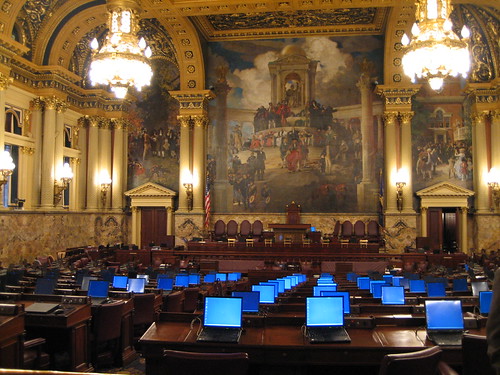
"Later, y'all! Y'inz! You guys!"

The last trickle of activity in the spring session of the Pennsylvania General Assembly carries on tomorrow, as the state Senate finishes some budget-related matters. The state House has already left town. And there's no truth to the rumor that they were run out of town on a rail. That's not even possible since they didn't invest anything in rail.

In the final weeks of June, all was largely quiet on the civil liberties front at the state capitol. That's a good thing. When the legislature starts screwing with civil liberties, it usually ends badly.

And it did end badly for women's access to reproductive healthcare. On June 17, Governor Corbett signed House Bill 818. This bill prohibits insurance companies from covering abortion care in policies in the insurance exchange, or marketplace, created by the federal healthcare reform law. Narrow exceptions exist only for rape, incest, and imminent death of the woman.

I've been trying to decide which is the most scandalous aspect of this story. Is it the state government meddling in a private transaction between a private company and a private customer, under the flimsy excuse that the exchange is administered by the government? (The federal government, mind you. The Corbett administration opted out of administering the exchange at the state level.) The supporters lamely claim that insurance coverage from Blue Cross is equivalent to Medicaid.

Is it the lack of a health exception that the Senate defeated, 24-26? Some women have serious complications in pregnancy that can lead to health problems but not death and that are best avoided via abortion. If a woman faces that crisis and has insurance through the exchange, sorry, she has to pay out of pocket. Here is how that vote went down.

Or is it the inability of the General Assembly to pass an infrastructure investment and repair bill (author's note: not a civil liberties issue) while finding the time to restrict women's access to comprehensive reproductive healthcare? Hey, a bridge might collapse, but at least they found time to restrict abortion!

Here at ACLU-PA HQ, Harrisburg, we're gearing up for summer work with legislators and staff on revising the child protective services law and revisions to the Right to Know law.

And here's something to look forward to in the fall: A storm is brewing over privacy and mass data collection, specifically in legislation to collect DNA from people who have not been convicted of a crime and to create a new database of Pennsylvanians' prescription drug use. These are issues where ACLU-PA gets to flex its nonpartisan cred by working with Republicans and Democrats who recognize that we do not want to go down the road of a Total Information Society.

So our legislators are (almost) out of here for the summer. They can enjoy their recess with the knowledge that their constituents will think of them everytime they bounce off a pothole in the middle of state route (fill in the blank). And we can rest assured that civil liberties are safe for the next two months. See you in September....

Labels: , , , , , , ,

Friday, March 07, 2008

Because if you can't trust your government...

The Washington Post had a breathlessly worded account yesterday of the federal government's way-cool neato computer-networked domestic intelligent system that will link it to the databases of several thousand law enforcement agencies.

From the article:
As federal authorities struggled to meet information-sharing mandates after the Sept. 11, 2001, terrorist attacks, police agencies from Alaska and California to the Washington region poured millions of criminal and investigative records into shared digital repositories called data warehouses, giving investigators and analysts new power to discern links among people, patterns of behavior and other hidden clues.

Those network efforts will begin expanding further this month, as some local and state agencies connect to a fledgling Justice Department system called the National Data Exchange, or N-DEx. Federal authorities hope N-DEx will become what one called a "one-stop shop" enabling federal law enforcement, counterterrorism and intelligence analysts to automatically examine the enormous caches of local and state records for the first time.

OK, the first obvious question: So just what have these people been doing for the past eight years? Under an administration whose No. 1 priority - supposedly - has been "the War on Terrorism," you'd think they would have been able to cobble together a decent database by now. But then I guess they've been too busy randomly snooping through all our e-mails.

Secondly: Does this make anyone else a bit nervous? Me too. But it's interesting that it didn't seem to bother much the two reporters who wrote the story. They treat the potential for privacy abuses as a mere afterthought - something thrown in the story to appease those nit-picky pro-Bill of Rights people (and the government knows who you are).

Here's how the article addresses the concern (way near the end of the story):
Authorities are aware that all of this is unsettling to people worried about privacy and civil liberties. Mark D. Rasch, a former federal prosecutor who is now a security consultant for FTI Consulting, said that the mining of police information by intelligence agencies could lead to improper targeting of U.S. citizens even when they've done nothing wrong.

The article then goes on to explain that there's really nothing to worry about because everybody promises to be really really good about not abusing the system. Whew, that's a relief.

But Washington Post investigative reporter Dana Priest, who didn't pen the original story, explains the very real concerns in her weekly on-line chat.

Here is the exchange with a reader.
From Savannah, Ga.: Dana, what's the flap about this new info sharing system? From what I read in the article, it only shares existing data. This presumably is collected legally, and I would hope that if something illegal were put into the system others would notice and highlight it. Anyway, this seems to be merely a case of reality catching up to Hollywood ... after all, we've been watching "CSI" and "NCIS" for years where they make a few keystrokes and a suspect's entire life comes pouring out. This was supposed to be one of the things put in after Sept. 11, correct?

Dana Priest: Ah ha? but was is "legal" information. Sure, if you get arrested that's one thing; or even picked up as a suspect in a crime. Let's use the example in the story: You have a flat tire near a nuclear power plant. The cop puts that into the data bases and discovers you've had three flat tires outside nuclear power plants in the last year. Now that's interesting and worth looking into, right? But does that mean something as simple and innocent has a flat tire gets added into the data base. Would that be legal? Switch out "flat tire" for "defaulting on a loan" or "attending a political rally" or "gun purchases" all legal things. Does it bother you that the police could link up your political rally attendance if they had some other reason to query your information? You see where it's going....lots of questions. Would have to have safeguards to make it acceptable, I'm certain.

Sadly, that point was never addressed in the original article.

Lauri in York

Labels: ,

Friday, January 05, 2007

Speedy delivery to the feds


National ACLU has announced that it is filing a Freedom of Information Act request to learn more about President Bush's signing statement regarding the opening of Americans' mail without a warrant.

It is worth noting that the Postal Inspector can open mail without a warrant if there is reason to believe that it contains dangerous material, like a bomb.
(ACLU Executive Director Anthony) Romero said the Bush signing statement does not specify whether there are special circumstances beyond those already established in the law that would allow him to open mail without a warrant and if so, what they may be. For example, the ACLU questioned whether the "exigent circumstances" would include the singling out of mail addressed to or from people on government watch lists, which are notoriously flawed. Such deliberate ambiguity, Romero said, "raises a red flag because of President Bush's history of asserting broad powers to spy on Americans."

Stay tuned. The hits just keep on comin'.

Andy in H-burg

Labels: , ,

Thursday, January 04, 2007

Here's the mail, it never fails


We just got a letter...if George W. Bush didn't take it. The New York Daily News reports today that El Presidente claims, via a signing statement, that he has the power to open every Americans' mail without a search warrant.
The President asserted his new authority when he signed a postal reform bill into law on Dec. 20. Bush then issued a "signing statement" that declared his right to open people's mail under emergency conditions.

That claim is contrary to existing law and contradicted the bill he had just signed, say experts who have reviewed it.

The man knows no bounds, does he? There is a place in America where the authorities open your mail without a warrant. It's called prison.

Andy in Harrisburg

Labels: , ,

Tuesday, December 05, 2006

We are shocked, shocked to find data-mining going on!

Guest Blogger: ACLU Member & Volunteer Herb Kestenbaum

Well, the feds are at it again, raking in billions of pieces of information on anyone entering or leaving the U.S. and somehow - we don't know precisely - deciding who among them could be today's or tomorrow's terrorists. And that data, about millions of American citizens as well as foreigners, will be kept for 40 years. It does not matter whether the data concerns those the government finds to be "innocent" or whether the information is accurate. And that mass of raw information held by Big Brother will be available - from our Department of Homeland Security - to other branches of government.

This is the Automated Targeting System. It was initially used to scan cargo. Now, it's being used on people, lumping people and products together as possible threats to national security.

So, when did this change happen? In 2002. When were we told? Last month. Can the data, if you could even get access to it, be checked for accuracy and be changed? No. Hell, you can check your financial credit rating, which affects part of your life, but you can't check your terrorist rating, which can affect your individual liberties and freedoms granted by the U.S. Constitution. Under the Bush regime, you have no right to review what may be inaccurate information, false accusations, discrimination based on race or religion or political beliefs or sexual preference. Nor can you limit who can use that information or to what purpose.

The feds just don't stop snooping, regardless of the cost to citizens. They tried to data-mine consumer and banking records to find patterns they said made people terrorist suspects. That was in 2002, and that program, the infamous Total Information Awareness, was killed. Undeterred, Big Brother - in that same year - just shifted its focus and created the latest outrage.

Where does this stop? When does the government start treating its citizens as private individuals, with the right to live their lives free of concern that the government not only is monitoring them but rating their loyalty and character as well?

More on the issue: ACLU press release; AP Story

Labels: ,