Tuesday, July 02, 2013

The rocky road of defending civil liberties in Harrisburg
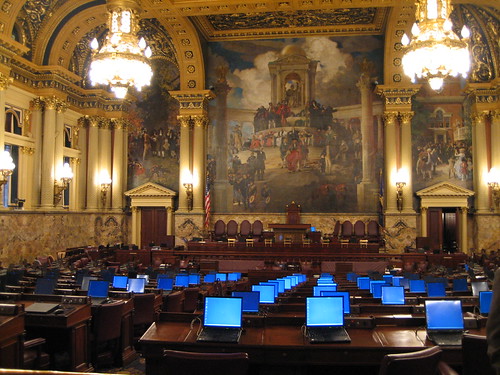
"Later, y'all! Y'inz! You guys!"

The last trickle of activity in the spring session of the Pennsylvania General Assembly carries on tomorrow, as the state Senate finishes some budget-related matters. The state House has already left town. And there's no truth to the rumor that they were run out of town on a rail. That's not even possible since they didn't invest anything in rail.

In the final weeks of June, all was largely quiet on the civil liberties front at the state capitol. That's a good thing. When the legislature starts screwing with civil liberties, it usually ends badly.

And it did end badly for women's access to reproductive healthcare. On June 17, Governor Corbett signed House Bill 818. This bill prohibits insurance companies from covering abortion care in policies in the insurance exchange, or marketplace, created by the federal healthcare reform law. Narrow exceptions exist only for rape, incest, and imminent death of the woman.

I've been trying to decide which is the most scandalous aspect of this story. Is it the state government meddling in a private transaction between a private company and a private customer, under the flimsy excuse that the exchange is administered by the government? (The federal government, mind you. The Corbett administration opted out of administering the exchange at the state level.) The supporters lamely claim that insurance coverage from Blue Cross is equivalent to Medicaid.

Is it the lack of a health exception that the Senate defeated, 24-26? Some women have serious complications in pregnancy that can lead to health problems but not death and that are best avoided via abortion. If a woman faces that crisis and has insurance through the exchange, sorry, she has to pay out of pocket. Here is how that vote went down.

Or is it the inability of the General Assembly to pass an infrastructure investment and repair bill (author's note: not a civil liberties issue) while finding the time to restrict women's access to comprehensive reproductive healthcare? Hey, a bridge might collapse, but at least they found time to restrict abortion!

Here at ACLU-PA HQ, Harrisburg, we're gearing up for summer work with legislators and staff on revising the child protective services law and revisions to the Right to Know law.

And here's something to look forward to in the fall: A storm is brewing over privacy and mass data collection, specifically in legislation to collect DNA from people who have not been convicted of a crime and to create a new database of Pennsylvanians' prescription drug use. These are issues where ACLU-PA gets to flex its nonpartisan cred by working with Republicans and Democrats who recognize that we do not want to go down the road of a Total Information Society.

So our legislators are (almost) out of here for the summer. They can enjoy their recess with the knowledge that their constituents will think of them everytime they bounce off a pothole in the middle of state route (fill in the blank). And we can rest assured that civil liberties are safe for the next two months. See you in September....

Labels: , , , , , , ,

Thursday, January 22, 2009

Change we can believe in

Here at the ACLU, we are non-partisan. We praise public officials when they do right by the Constitution and civil rights. And we wack them when they fail our freedoms.

There's so much good news in Day 2 of the Obama administration, it's hard to know where to begin. So let me just bullet point them for you.
  • This morning, President Obama signed executive orders to close the detention center at Guantanamo Bay and the CIA's secret prisons around the world. The message is clear: The United States is not a country that holds people indefinitely without charge and without trial.
  • Yesterday Obama signed an executive order placing a presumption of openness on all government records. (I'm not sure how he did this without legislation, but hey, we'll go with it.) In the past, a person pursuing a government record had to prove why it should be open. Now the government must prove why it should be secret. This is the same reform that Pennsylvania passed into law last year.
But it wasn't all good news. Last night NSA whistle blower Russell Tice, who is a former analyst with the agency, told Keith Olbermann on MSNBC that the NSA spied on journalists inside the United States.


Andy in Harrisburg

Labels: , , ,

Tuesday, April 22, 2008

Search for open records director held in secret

That sounds like a headline from The Onion. Pennsylvania's new open records law is a good thing. It puts the burden of proof on the government to show why a record should not be public, rather than on the person making the request to show why it should be, which is how we did it in the past. And it creates an agency for dealing with open records requests.

But this makes me laugh.
Six people interviewed for the post, but (Rendell spokesman Doug) Rohanna didn't name the candidates.

Senate Majority Leader Dominic Pileggi, R-Delaware, who sponsored the open-records legislation, said he is troubled by the closed process used to identify potential candidates for the executive director's job.

He noted he saw no advertisement for the job.

Only in Harrisburg.

Andy in The Twilight Zone, errr, Harrisburg

Labels:

Friday, December 21, 2007

Documents must remain public

Pennsylvania lawmakers, before scurrying off for the holidays, almost- but not quite- approved a bill that would overhaul the state's pathetic excuse for an open-records law. So, when they return in January, they will begin the process of winnowing through 19 last-minute amendments inserted into the bill.

In what has become almost a mantra, editorial page writers support the legislation, describing the existing open-records law in Pennsylvania as "woefully ineffective." And while the revisions passed by the House are far from perfect, they say it's an improvement over existing law. See here and here. But in its Sunday editorial, The Patriot-News addressed a provision in the bill that hasn't gotten enough attention.

Under existing open-records law, coroner reports are considered to be public documents. But under the proposed bill, they would no longer be generally available to the public.

According to the editorial:
While the argument is made that open autopsy reports would lead to their misuse, the fact is that they are open under existing law and there is virtually no record of misuse. This is a solution to a problem that doesn't exist.

Pete Shellem, an investigative reporter with The Patriot-News, has uncovered information that over the years has freed four innocent people unjustly convicted of murder from prison. (The American Journalism Review did a great profile on him in July.) Last week, Shellem spoke to the ACLU's south-central PA chapter about the open-records bill. He says when he begins an investigation, he usually begins with the coroner's report of the murder victim. He's gotten some pretty important information from the documents - key information overlooked by both prosecutors and defense attorneys.

So, it's crucial that in the final version of any open-records law that these documents remain available to the public. Closing these records would eliminate a critical oversight the press now has into the legal system

And while the documents would be public record if introduced into evidence during a trial, Shellem pointed out that frequently cases don't go to trial. Often, the accused accepts a plea bargain, pleading guilty in exchange for a lighter sentence.

And, as Shellem pointed out, every innocent person behind bars means a guilty person out walking the streets.

Lauri in York

Labels: ,