Tuesday, July 02, 2013

The rocky road of defending civil liberties in Harrisburg
"Later, y'all! Y'inz! You guys!"

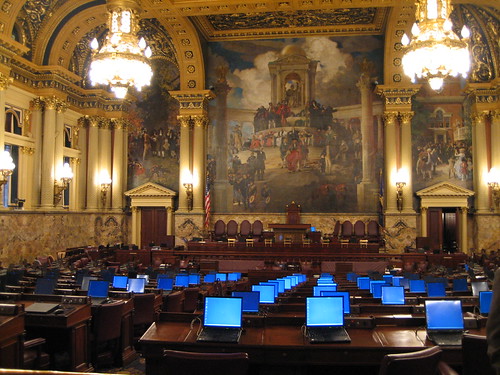
The last trickle of activity in the spring session of the Pennsylvania General Assembly carries on tomorrow, as the state Senate finishes some budget-related matters. The state House has already left town. And there's no truth to the rumor that they were run out of town on a rail. That's not even possible since they didn't invest anything in rail.

In the final weeks of June, all was largely quiet on the civil liberties front at the state capitol. That's a good thing. When the legislature starts screwing with civil liberties, it usually ends badly.

And it did end badly for women's access to reproductive healthcare. On June 17, Governor Corbett signed House Bill 818. This bill prohibits insurance companies from covering abortion care in policies in the insurance exchange, or marketplace, created by the federal healthcare reform law. Narrow exceptions exist only for rape, incest, and imminent death of the woman.

I've been trying to decide which is the most scandalous aspect of this story. Is it the state government meddling in a private transaction between a private company and a private customer, under the flimsy excuse that the exchange is administered by the government? (The federal government, mind you. The Corbett administration opted out of administering the exchange at the state level.) The supporters lamely claim that insurance coverage from Blue Cross is equivalent to Medicaid.

Is it the lack of a health exception that the Senate defeated, 24-26? Some women have serious complications in pregnancy that can lead to health problems but not death and that are best avoided via abortion. If a woman faces that crisis and has insurance through the exchange, sorry, she has to pay out of pocket. Here is how that vote went down.

Or is it the inability of the General Assembly to pass an infrastructure investment and repair bill (author's note: not a civil liberties issue) while finding the time to restrict women's access to comprehensive reproductive healthcare? Hey, a bridge might collapse, but at least they found time to restrict abortion!

Here at ACLU-PA HQ, Harrisburg, we're gearing up for summer work with legislators and staff on revising the child protective services law and revisions to the Right to Know law.

And here's something to look forward to in the fall: A storm is brewing over privacy and mass data collection, specifically in legislation to collect DNA from people who have not been convicted of a crime and to create a new database of Pennsylvanians' prescription drug use. These are issues where ACLU-PA gets to flex its nonpartisan cred by working with Republicans and Democrats who recognize that we do not want to go down the road of a Total Information Society.

So our legislators are (almost) out of here for the summer. They can enjoy their recess with the knowledge that their constituents will think of them everytime they bounce off a pothole in the middle of state route (fill in the blank). And we can rest assured that civil liberties are safe for the next two months. See you in September....

Labels: , , , , , , ,

Monday, June 03, 2013

Top 5 Reasons Pennsylvania May Not be the next DNA collection State

Today's Supreme Court decision that upheld Maryland's preconviction DNA collection law was pretty much atrocious, as pointed out earlier by my colleague Ngani. But there's no guarantee that Pennsylvania will be next. Here's why, from the home office in Harrisburg, Pennsylvania.

5. Last year the state Senate passed a preconviction DNA bill. It was rejected by the state House. In October, the House passed an amendment by a freshman Democrat, Representative Brandon Neuman of Washington County, that gutted the bill, including the DNA collection provision with 132 votes in favor of the amendment. This bipartisan coalition included the Speaker of the House.

4. The public safety arguments fall flat. In 2011, Maryland collected 11,000 DNA samples from people charged but not yet convicted of a crime under its law. That led to nine additional convictions for unsolved crimes. Not 90. Not 900. Not 9,999. But nine. Plus, under the commonwealth's current, postconviction DNA law, the Pennsylvania State Police (PSP) has a backlog of eight months to test DNA samples, a backlog that will only balloon if the legislature passes a preconviction collection bill. No one can argue with a straight face that preconviction DNA collection protects public safety.

3. It's expensive. PSP has estimated that preconviction DNA collection would cost $13 million.

2. The right to privacy under the state constitution is robust. Pennsylvania courts have consistently ruled that Article I, Section VIII of the state constitution provides greater privacy protections in search-and-seizures than the Fourth Amendment of the federal constitution.

1. The ACLU of Pennsylvania is on it. And we're awesome.

Labels: , , ,

Monday, October 29, 2012

State legislature, governor re-victimize victims: Part Two

The new sexting law is not the only way in which the General Assembly and Governor Corbett have harmed victims recently. They also managed to pass a new law that does nothing for victims of sexual assault while ratcheting up the hysteria over HIV-AIDS.

House Bill 1794, now Act 201 of 2012, passed the legislature two weeks ago and was signed by the governor on Thursday. This new law allows a district attorney to seek and a judge to order a forced HIV test of a person arrested for sexual assault. (The ACLU of PA supports universal HIV testing but opposes forced testing of anyone.) The DA must seek the order in consultation with the victim.

That sounds great on its face. Right, only to people who know nothing about HIV. The Centers for Disease Control and Prevention has a recommended protocol for people who may have been exposed to HIV. It involves a regimen of drugs known as post-exposure prophylaxis, or PEP. PEP reduces the chances that a person will contract HIV after possible exposure.

This drug regimen must be started within 72 hours of the exposure. Ideally, it is started within 2-36 hours. What are the chances that a suspect is arrested, the DA consults with the victim, the DA seeks the order, a judge issues the order, an HIV test is administered on the arrestee, and the results are returned within 72 hours? Slim to none.

This new law is also based on the false idea that everyone who is arrested must be guilty. Google "innocence project" and you'll know that's not true. According to the Innocence Project, "there have been tens of thousands of cases where prime suspects were identified and pursued—until DNA testing (prior to conviction) proved that they were wrongly accused."

Imagine this nightmare scenario. The DA has arrested the wrong person, and he's HIV positive. What kind of additional trauma will that place on the victim? Or imagine that they've arrested the wrong person and he's HIV negative, giving the victim a false sense of security.

People with HIV can also test negative. In the first six weeks to six months that a person has contracted the disease, he or she tests negative. This is also the time in which the person is most likely to transmit the disease because his viral load is high.

There is another factor here, a fact that is little discussed. Transmission of HIV is relatively rare. According to one study, a person with HIV will transmit the disease to a partner once in every 900 unprotected sexual encounters. According to the CDC, transmission by consensual vaginal intercourse is 0.1%-0.2% and by consensual anal intercourse is 0.5%-3%. (Transmission rates by sexual assault are not known.)

Of course, safe sex is extremely important to slow the spread of HIV. But this new law is based on the false idea that exposure equals transmission. It does not. 

According to a 2009 survey by the Kaiser Family Foundation, 51 percent of people would be uncomfortable having their food prepared by someone who is HIV positive. This law is based on the same wrong-headed attitude toward HIV. It furthers the hysteria around HIV, and that leads to those living with the disease to be further ostracized and isolated.

Sexual assault victims need the best care possible, and that care comes from medical professionals, not DAs or judges.

Learn more about the ACLU's work on HIV-AIDS by visiting the webpage of our AIDS Project.

Labels: , , ,

State legislature, governor re-victimize victims: Part One

For all of the rhetoric around crime victims' rights at the General Assembly, it's hard to believe that any legislation that harms victims could ever be passed. But that's exactly what happened two weeks ago. And it happened twice.

Two weeks ago, the legislature passed House Bill 815, and the governor signed it on Thursday, now Act 198 of 2012. This bill creates a new crime of teen "sexting." You're probably familiar with sexting by now, but if not, it is a term used to describe a wide range of activity that involves photos, sex, and electronic communication. Basketball fans, think Greg Oden.

Act 198 creates summary and misdemeanor offenses that involve sexting by kids between the ages of 13 and 17. The charge is based on the circumstances of the activity.

Imagine this scenario. Two 17-year-olds are dating and send pictures of themselves in various stages of undress. Newsflash: Teens are clumsy with their sexuality. Teens have been exploring their sexuality since our species evolved and don't always do it in a mature way. That's not exactly earth-shattering news.

So she dumps him. In anger, he sends her semi-nude photo to the entire school. She's a victim of abuse, right? Well, under Act 198, she's a criminal because she produced the photo and sent it to her then-boyfriend. She could be charged with a summary offense.

There have been some tragic incidents that have involved teens sexting. And the supporters of HB 815, including the Pennsylvania District Attorneys Association, have used these incidents to push for this bill. The DAs used these incidents in which kids were abused to push for a bill- now law- that will criminalize these victims, which will only compound their suffering. Incredibly, some so-called victims' advocacy groups supported the bill, too.

Supporters of HB 815 claim that all sexting by teens (under the age of 18) is currently felony child pornography, even if the person in the photo also produced it. The DAs think that if they say something is a crime, then it's a crime. 

They fail to respect the role of the judge in our judicial system. Not a single court in Pennsylvania has upheld a felony charge in a sexting situation. Not one.

So, parents, make sure that sexting is part of The Talk with your kids. And in Pennsylvania, be sure that they understand that sexting, even if it's consensual, could lead to a visit from their local DA, who apparently is more concerned about what teens do in their bedrooms than he is about real criminals.

A second post is coming about how the legislature and the governor harmed victims with ill-advised legislation.

Labels: , , , ,

Wednesday, October 03, 2012

State Senate makes subtle but important change to gang legislation

Yesterday the Pennsylvania Senate quietly amended a piece of legislation that illustrated how effective the ACLU of Pennsylvania can be at the state legislature.

House Bill 1121 creates a new offense of "recruiting criminal gang members" and tasks the Commission on Sentencing with creating a sentencing enhancement for a person convicted of committing a crime of violence on behalf of a gang. This bill had numerous civil liberties problems, including First Amendment issues, too much potential for discrimination, and its impact on prison crowding. We said as much in a memo (pdf) sent to the Senate Judiciary Committee and the House Judiciary Committee last week. 

When the bill left the Senate Judiciary Committee last week, HB 1121 defined a "criminal street gang" like this:
"A FORMAL OR INFORMAL ONGOING ORGANIZATION,
ASSOCIATION OR GROUP, WITH OR WITHOUT AN ESTABLISHED HIERARCHY,
THAT HAS AS ONE OF ITS PRIMARY ACTIVITIES THE COMMISSION OF
CRIMINAL OR DELINQUENT ACTS AND THAT CONSISTS OF THREE OR MORE PERSONS WHO HAVE A COMMON NAME OR COMMON IDENTIFYING SIGNS, COLORS OR SYMBOLS THAT LAW ENFORCEMENT PERSONNEL USE TO IDENTIFY THE GROUPS OR SUBGROUPS."
This screams, "First Amendment." Criminalizing "signs, colors or symbols" is problematic and giving law enforcement the power to determine what is and is not illegal gives the executive branch entirely too much power.

When HB 1121 left the Senate Appropriations Committee on Tuesday, that definition had been amended. It now says:
"A FORMAL OR INFORMAL ONGOING ORGANIZATION ,
ASSOCIATION OR GROUP, WITH OR WITHOUT AN ESTABLISHED HIERARCHY,
THAT HAS AS ONE OF ITS PRIMARY ACTIVITIES THE COMMISSION OF
CRIMINAL OR DELINQUENT ACTS AND THAT CONSISTS OF THREE OR MORE PERSONS."
Note the deletion of the "signs, colors or symbols" language. This is important. This change will keep people from getting rung up under this law for wearing the wrong colored shirt. And, although it doesn't eliminate this danger altogether, it lessens the ability of law enforcement to use arbitrary criteria against young men of color.

I tweeted about this and a few other issues in the cheeky way that occasionally gets me in trouble at the legislature, so I want to give a tip of the hat to the state Senate for altering this bill in this way.

Don't get me wrong, this bill still has problems. There is a risk of it being used disproportionately against young black and brown men, and it has the potential to add to the slow drip that leads to a bursting prison system.

We can't stop this bill, though. It's being pushed by the Senate Majority Leader. But sometimes at the state capitol we take our wins where we get them. Sometimes we're grateful that we get important alterations to bills, grateful that someone listened, and live for the next debate.

Labels: , ,

Monday, May 14, 2012

A swab in the cheek while the State Police cracks

Today the Pennsylvania Senate Law and Justice Committee and the House Judiciary Committee held a joint hearing in Gap, Lancaster County, on the plans by the Pennsylvania State Police to close its barracks in Ephrata and to downgrade the status of Troop J, the local PSP headquarters, to a substation. The latter move would lead to numerous services of the state police moving elsewhere.

PSP Commissioner Frank Noonan testified and was followed by several local leaders. Noonan said that the state police is currently 435 troopers short of its full complement, statewide, and expects to be at 500 short by the time the next class of cadets graduates from the academy. The locals, including the chairman of the county commissioners, the district attorney, and the chief of police in the city of Lancaster, protested PSP's planned closure.

Could PSP use $13 million? That's Noonan's estimated cost of Senate Bill 775, a bill to collect DNA from people who have not been convicted of a crime but who have been arrested for a felony or one of several designated misdemeanors. We oppose this bill because taking a DNA sample from someone is a search, and in order to conduct this search, the government needs a finding of probable cause that it will produce evidence of a crime. The high state court in Maryland recently came to the same conclusion. DNA collection from people who have not been convicted of a crime turns innocent-until-proven-guilty on its head.

The pricetag isn't the only significant practical problem with this bill. PSP's DNA caseload will increase from 23,000 samples per year to 121,000 samples per year, according to an article published in the Philadelphia Inquirer in February. Under current law, in which DNA is taken from those convicted of a felony or one of the designated misdemeanors, it takes eight months to analyze a DNA sample. The wheels of justice could come to a grinding halt if SB 775 becomes law.

Incredibly, in this environment, the House Judiciary Committee is rumored to be taking up SB 775 before the end of June. While local leaders gnash their teeth over the closure of a nearby state police barracks and while PSP leaders decry their shortage of troopers, the legislature may take up this bill to place a new and expensive burden on the state police.

How many troopers could the state hire with $13 million?

Labels: , , ,

Friday, October 28, 2011

Let the courts decide?

PA State Senators are avoiding their obligation to be the first line of defense for the Pennsylvania Constitution. 

On Wednesday, the State Senate passed Senate Bill 1, the taxpayer-funded private school vouchers bill, by a slim majority, 27-22. Its opponents have a litany of concerns with the bill and the harm it could cause to education in Pennsylvania. One of their most serious concerns is that the bill would almost certainly violate the Constitution of the Commonwealth of Pennsylvania. But unfortunately, Senators supporting the bill have decided to punt the issue to judges. They plan to enact SB 1 without considering whether it contradicts the Commonwealth’s constitution. 

SB 1 would create a program through which the state would provide vouchers to students at Pennsylvania’s lowest performing schools. They could use these vouchers to pay to attend a private school. According to Senator Anthony Williams, one of the bill’s co-sponsors, and the Senate Republicans’ fiscal analysis, no more than about 10% of students at these schools would likely participate and receive vouchers. The money for the vouchers would come directly out of the budgets of the school districts that students were leaving. 

The constitutional problems with the bill arise from the provisions about where vouchers can be spent. Families that receive vouchers can use them to pay to attend any private school—including a religious private school. SB 1 does not require that the voucher funds do not help pay for religious instruction. 

Pennsylvania’s constitution could not be much clearer that the legislature is not allowed to pass a law like this one. A legal analysis by ten state and national organizations, including the American Civil Liberties Union of Pennsylvania, the Education Law Center, and the Pennsylvania State Education Association, concluded that SB 1 would violate no fewer than four separate provisions of the state constitution. For example, Article III, Section 15 commands, “No money raised for the support of the public schools shall be appropriated to or used for the support of any sectarian school”. Despite the constitutional command, SB 1 takes money used for public schools and uses it to pay for vouchers to attend sectarian schools. There is little room for doubt: SB 1, if it became law, would be unconstitutional. 

So why are legislators spending their time trying to pass it? Senator Jim Ferlo of Pittsburgh asked that question at the Senate Education Committee’s meeting on October 24. Senator Williams’ responded that the legislature should pass the bill and let the courts decide whether it is constitutional or not. After all, the Supreme Court of Pennsylvania is the final authority for the meaning of the Pennsylvania Constitution. 

But the senator left out a critical point: the Supreme Court is not the only authority responsible for protecting Pennsylvania’s constitution. 

Every legislator, before taking office, swore, “I will support, obey and defend the Constitution of the United States and the Constitution of this Commonwealth". This oath is written into the Pennsylvania Constitution, and it is the same oath that judges take. It means that legislators have a duty to try not to pass laws that will violate the constitution and undermine the legal foundations of the Commonwealth. 

Yes, the justices of the Supreme Court of Pennsylvania are the last line of defense for the state constitution. But the legislators are the first.  

Nathan Vogel, Frankel Legislative Fellow, ACLU of PA  

Cross-posted at RocktheCapital.com

Labels: , ,

Wednesday, October 19, 2011

Greetings from Harrisburg! House Bill 934 with its voter ID mandate will effectively disenfranchise hundreds of thousands of Pennsylvanians. Wendy Bookler talks about her 93-year-old mother, Bea, who has voted in every presidential election since 1940. If HB 934 is enacted, Bea will lose the vote. 

Wendy is also on the board of the SeniorLAW Center, one of our allies in opposing HB 934.  

Please note that by playing this clip YouTube and Google will place a long-term cookie on your computer.  Please see YouTube's privacy statement on their website and Google's privacy statement on theirs to learn more. To view the ACLU of PA's privacy statement, click here.

Labels: , , , ,

Tuesday, July 12, 2011

As goes Kansas, so goes Pennsylvania?

Pro-big-government activists are implementing their strategy to rollback women's access to reproductive healthcare all over the country, not just in Pennsylvania. The strategy goes a little something like this: Alter the legal requirements for abortion clinics, under the guise of "patient safety" (because we're all supposed to believe they want women to have safe access to abortion), and then watch the clinics scramble to meet the requirements. Poof! No more access to safe abortion!

Note that I didn't say no more abortions. There will still be abortions. With less clinics able to offer care, though, women seeking abortions will potentially seek care via less safe methods, including self-induced abortions and from illegal providers like Kermit Gosnell.

Pennsylvania is facing that threat with Senate Bill 732 and House Bill 574, both of which have passed one chamber of the state legislature. WPSU-FM laid out the arguments in a story yesterday.

The pro-big-government activists have pursued a similar strategy in Kansas. The requirements were different, and the KS Department of Health only gave the clinics two weeks to react. But the strategy is the same.

Here in PA, we've predicted that the enactment of SB 732 or HB 574 could lead to clinics closing or no longer offering abortion services. It would also likely lead to costly litigation.

And that's exactly what has happened in Kansas. Two of the state's three clinics were unable to comply, and they filed suit. A federal judge ruled in their favor and imposed a temporary restraining order on the new legal requirements.

Some states have implemented ambulatory surgical facility regs on abortion clinics that offer abortion beyond a certain period of weeks gestation, but we are aware of no state that has implemented ASF regs for all abortion clinics like SB 732 and HB 574. If enacted, this law would make Pennsylvania the most extreme of the extreme. And like Kansas, Pennsylvania can expect a costly constitutional lawsuit on its hands.

Labels: , , , ,

Wednesday, June 08, 2011

Greetings from Harrisburg! Reproductive rights in crisis in PA

The state Senate passed an amendment today (June 8) to require freestanding abortion clinics to follow the same regulations as ambulatory surgical facilities. Learn more about this and the latest on an attempt to require all voters at every election to show photo ID.


Please note that by playing this clip YouTube and Google will place a long-term cookie on your computer. Please see YouTube's privacy statement on their website and Google's privacy statement on theirs to learn more. To view the ACLU of PA's privacy statement, click here.

Labels: , , , ,

Tuesday, February 08, 2011

Then they came for immigrants and poor people....

Two weeks ago, we told you that the first bill to get a committee vote in the state Senate was Senate Bill 3, to roll back women's access to abortion care. Today we learned that immigrants and poor people are next on the Senate's list.

The Senate State Government Committee today passed Senate Bill 9, requiring applicants for many public aid programs to show government-issued identification, with some exceptions. I wrote about this bill last week, so there's no need to rehash our arguments.

But there is a genuine level of disappointment here about the direction the Senate is heading when the first two bills to come out of committee restrict women's access to healthcare and restrict citizens' access to social safety net programs like unemployment compensation. Who and what is next? LGBT people? Prisoners? Voting rights? Apparently, the budget deficit, the economy, and government reform are nowhere on the radar screen, based on these first few weeks. If this keeps up, we're in for a bumpy session.

Update, 3:05pm: Factual error on my part. About an hour before the committee vote, the Senate Judiciary Committee passed seven bills, so SB 9 wasn't the second bill out of committee this session in the Senate. Still, the point is the same.

Labels: , ,

Wednesday, January 26, 2011

First they came for women's healthcare....

So, Pennsylvania voter, you thought the 2010 election was about state government spending and a sluggish economy. Ha! Sucker.

No, apparently the top priority in our state Senate is not filling the approximately $4 billion budget hole for next year or wrestling with job growth or figuring out what to do about our looming crises in state pensions and corrections. Instead, the very first bill to be passed out of a Senate committee this session is on abortion. That is not a typo.

Despite the many challenges facing our commonwealth, the Senate Banking and Insurance Committee yesterday passed Senate Bill 3. This bill would ban insurance companies from offering abortion coverage in the health insurance exchanges created by the federal Affordable Care Act, aka healthcare reform, except in cases involving rape, incest, or when the mother's life is in danger. Even the rape and incest exceptions come with hurdles that could lead women to not have coverage.

(Pause for background: The exchanges provide a place where insurance companies can find more customers and customers can find lower rates because they are participating in a group, rather than as individuals. Essentially, it's a way for people without health insurance to shop for it. The exchanges were created by the federal law but will be administered by the states.)

Numerous senators and their staffers thought they were voting to prohibit coverage for taxpayer-funded abortions. The ACLU would oppose that, too, because we don't think poor women should be denied safe and critical care, but SB 3 goes much further. It completely bans insurance companies from covering abortion for customers in the exchanges, including those who pay for the coverage with their own money.

In fact, the Affordable Care Act already prohibits patients who get government subsidies from using the subsidies for abortion coverage. If a woman who participates in the exchange wants abortion coverage, she must get separate coverage and make a separate payment with her own money.

SB 3 wedges the government between a private insurance company and its customer. Talk about a government takeover of healthcare.

Looming over this debate is the recent indictment of Dr. Kermit Gosnell in Philadelphia. Dr. Gosnell is accused of running an abortion clinic in which he allegedly killed live babies and one woman.

What our legislators don't get- and what we as civil libertarians have to push- is that there will be more Dr. Gosnells if the government continues to make it difficult for women to access safe abortion care. The Gosnell story gives us a look at a dark day in the future, if women cannot get the care they need. The back alley abortion will return.

We don't want to get to that day. SB 3 must be stopped.

Labels: , ,

Wednesday, October 06, 2010

PA Legislature Gets Smart on Crime


In July, I declared on this blog that prison reform was on life support. What a difference three months can make.

On Monday, the state House passed Senate Bill 1161. This bill takes on several reforms of Pennsylvania's criminal sentencing and parole regimes:
  • Tasks the Commission on Sentencing to devise guidelines for judges to use to consider what threat to public safety a defendant poses and what potential for rehabilitation that defendant has.
  • Empowers the Board of Probation and Parole to parole inmates at their minimum sentence if the only reason not to parole them is their inability to finish required programming, e.g. drug and alcohol counseling, with the expectation that the person will finish the programming on parole
  • Allows the board to implement evidence-based practices to determine when technical parole violators (those who violated parole but did not commit a new crime) should be reincarcerated and when they should stay on the outside.
Because the House amended the bill, it will have to go back to the Senate for a vote on concurrence before going to Governor Rendell. That Senate vote needs to happen next week, as it is the Senate's last week of session for the year.

All of these reforms will require a willingness to carry them out. The Commission on Sentencing guidelines are intended for judges to send offenders to alternative programs either short of prison or within prison that could lead to their early release. And allowing the Board of Probation and Parole to utilize certain alternative ideas will be completely ineffective if the board doesn't actually use them.

But the value in this exercise has been continuing the conversation about Pennsylvania's bloated prison system. The Department of Corrections is currently several thousand inmates over capacity, to the point that 2,000 inmates have been sent out of state. We're going to spend nearly $1 billion over the next three years to build four new prisons.

Meanwhile, other states are decreasing their prison populations. Why not Pennsylvania?

The reforms in SB 1161 are modest, and we're disappointed that the House amended out the provision that allowed inmates to be released to pre-release centers within 18 months of their minimum sentence. We'd like to see the legislature move reforms to mandatory minimum sentences recommended by the Commission on Sentencing. The General Assembly must address flaws in the State Intermediate Punishment program and in the Recidivism Risk Reduction Initiative that make those programs less effective than they could be.

But passing this bill is another sign that the legislature is finally getting smart on crime. And that is a welcome change.

Andy in Harrisburg

Labels: , , ,

Wednesday, September 29, 2010

Did our state legislators flunk high school civics?


Three weeks ago, the Court of Appeals for the Third Circuit ruled that the Hazleton anti-immigrant ordinance is unconstitutional, including its provision mandating the use of the federal E-Verify program. Yesterday the Senate State Government Committee passed a bill forcing state contractors to use E-Verify, House Bill 1502.

You read that right. Read it again, if you must.

In Lozano et al. v. Hazleton, the Third Circuit ruled that local governments cannot mandate E-Verify for a group of employers if Congress has left it voluntary for those employers. Clearly, state contractors are one of those groups since the federal government has only mandated E-Verify on federal contractors and even then only in narrow circumstances.

Maybe the Senate State Government Committee doesn't like it, but the judiciary does have an equal role in our system of government. Only Senator Mike Folmer of Lebanon voted no.

The House doesn't get away either. On the same day that the Senate committee passed HB 1502, the House State Government Committee passed HB 2479, Rep. Daryl Metcalfe's bill to copy Arizona's "show me your papers please" law. HB 2479 also has a provision requiring the use of E-Verify for all employers.

You may recall that a federal court struck down the Arizona law, and while that ruling is not binding in Pennsylvania, it certainly sets a path for courts and legislatures to follow. And again, there is that pesky Third Circuit ruling in the Hazleton case.

Committee chairwoman Rep. Babette Josephs didn't want to bring HB 2479 up for a vote, but her hand was forced when Metcalfe filed a discharge petition, a procedural move that allows reps to bring a bill out of committee without the committee's approval. All of the Republicans and Democratic Reps. Mike Carroll, John Galloway (the primary sponsor of HB 1502), and Jaret Gibbons voted yes, and the bill passed the committee, 13-9.

Hovering over the E-Verify issue is a case that will be heard this session by the United States Supreme Court. The court will hear arguments in Chamber of Commerce v. Candelaria, which is a challenge to Arizona's law mandating E-Verify for all employers. By next June, we'll have some guidance from the Supreme Court on what states can and cannot do with E-Verify.

But, eh, who needs court rulings and case law and that old piece of paper, the Constitution, when there are campaign contributors and the anti-immigrant mob to satisfy?

Andy in Harrisburg

Labels: , , ,