Wednesday, March 31, 2010

The problem with forcing schools to call the police

I realized after writing Friday's post that each of those issues could be a post all to themselves and that you, dear reader, would be best served by further fleshing out the issues, especially the police in schools bill (SB 56) and the sexting bill (HB 2189). (The gay foster kids issue is pretty clear. It's horrendous what the legislature has done on that issue.)

SB 56 mandates reporting of criminal offenses on campus by school administrators to both local police and to the state Department of Education's Office of Safe Schools. The primary sponsor has a school in his district that was calling the police for student incidents but not reporting those incidents to the Office of Safe Schools. By not reporting to the office, the school avoided being tagged as an unsafe school.

So it makes sense to put some guidelines in place to be sure that schools are not ducking the Office of Safe Schools. And, of course, all of us want some incidents reported to the police. If a homicide occurs in a school, I'm pretty sure that everyone wants the school to call the cops.

But once you get past the obvious, things get murkier the further you go down the list of offenses. Here's an example that is nearly identical to a real incident. Say a teacher who doesn't understand autism touches a kid who is on the spectrum. Kids with autism don't like to be touched. The kid reacts by kicking the teacher in the leg. The act itself is simple assault, but because the victim is a school employee, it's aggravated assault.

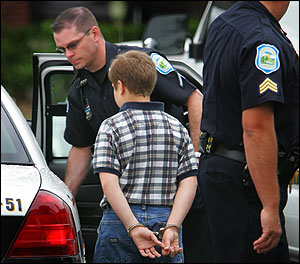
Under SB 56, school administrators have discretion on whether or not to call the police on simple assault but must call the police for aggravated assault, under threat of a fine of several thousand dollars. So if this bill becomes law, that kid gets hauled off by the police, and it doesn't matter if he's 7 or 17. Think for a moment about just how traumatic it would be for a child, any child, to be taken from school in handcuffs.

With administrators having the discretion to report simple assault but being mandated to call the police for aggravated assault, school administrators will be left to determine where particular offenses fit in the criminal code. Third degree institutional vandalism must be reported to the police, under SB 56, but lesser forms of vandalism do not. If you're an administrator and you have a $2500 fine hanging over your head, you're probably going to err on the side of caution and report all forms of vandalism and all forms of assault. Why risk money coming out of your pocket or your school district's pocket?

A problem already exists with schools relying too heavily on police back up to deal with discipline problems. In the 2006-07 school year, law enforcement in Pennsylvania found just 60 percent of incidents reported by schools to be arrest worthy. In other words, police considered 40 percent of the school-based complaints they received to be unworthy of their attention. Schools are calling the police too much, and that's without SB 56 in law.

Ironically, one of the issues coming out of the inter-branch commission on juvenile justice has been that there were too many school-based calls going into police stations in Luzerne County. The excessive use of law enforcement by school officials funneled kids into the juvenile justice system, where two Luzerne judges allegedly took bribes to send kids to detention facilities.

We don't know the future of this legislation. It passed the Senate last year. It has not yet been taken up by the House, but it's possible that there will be a massive (omnibus) bill related to school issues. SB 56 could be in it. It's hard to imagine the Pennsylvania General Assembly doing any worse by our kids.

Andy in Harrisburg

Labels: , ,

Friday, March 26, 2010

The kids are alright. But the adults are screwed up


The 2009-10 legislative session at the PA state capitol is my first full session as ACLU-PA's legislative director. I've been learning a lot and really enjoying the work.

One thing that I've learned is that state legislators really despise our kids. Ok, that's an exaggeration, as I am wont to do in my blogging. I'm sure legislators don't actually despise Pennsylvania's kids.

But based on some of the initiatives that are being pushed at the state capitol, one couldn't help but think that our elected officials have completely forgotten what is was like to be a kid and are not consciously aware of the damage that some of their ideas would do to the commonwealth's children. Consider:

Police in schools. Last year, the Senate passed Senate Bill 56, a bill that mandates public school administrators to call local police when certain offenses occur in school. The original bill was spectacularly draconian, even requiring school administrators to call the police for disorderly conduct and tobacco possession. To the credit of the primary sponsor, Senator Jeffrey Piccola of Dauphin County, some of the most egregious provisions were amended out of the bill.

But the bill is still a raw deal for Pennsylvania's children, especially younger children and kids with disabilities. There are no provisions to give administrators discretion for students' with intellectual disabilities or for younger students. A kindergarten student is held to the same standard as a senior in high school.

Do you think a kindergarten student couldn't be hauled off in handcuffs by the police? SB 56 could make it a more frequent occurrence.

We are hearing rumblings that a massive bill on the public school code will be part of this year's budget and that Senator Piccola is insisting that SB 56 be included in that bill.

Sexting. We all agree that it is a really bad idea for young people to send nude or sexually provocative digital photos of themselves to their partners and friends. A photo like that might never go away.

The answer to this issue, according to Pennsylvania's district attorneys and some legislators, is to arrest the kids, including the kid who willing takes a picture of him- or herself and sends it to a willing participant, e.g. a boyfriend or girlfriend. And here's the best part: Some DAs claim that they are helping these kids. By arresting them.

Sexting is dumb behavior. It's also borne out of growing young people's desires to explore their sexuality, a natural part of being human. And the legislature and DAs in PA think they should be arrested for it.

House Bill 2189 would make all forms of sexting a misdemeanor. The bill passed out of the House Judiciary Committee last week after a failed attempt by Rep. Kate Harper of Montgomery County to further downgrade this "crime" to a summary offense.

Meanwhile, over the last two weeks, legislative chambers in Florida and Illinois have also passed bills on sexting. Bills that made it a summary. Do kids have a friend in Pennsylvania?

Gay foster kids. It's hard to believe that anyone could think it's ok to discriminate against gay foster kids. LGBT foster kids often face abuse, as was well articulated in an op-ed this week by Cei Bell that was published in the Philadelphia Daily News.

In 2007, Rep. Phyllis Mundy of Wilkes Barre introduced a bill that she called a Foster Kids' Bill of Rights. The bill included a non-discrimination provision that included protection for foster kids based on race, color, religion, disability, sexual orientation, national origin, age or gender. When the bill got to the floor of the House, it was amended to water down the non-discrimination provision and essentially make it a suggestion but without the power of law. Why did this happen? Because the Pennsylvania Catholic Conference didn't want the protection for gay foster kids. I kid you not.

What kind of behavior, exactly, does the Catholic Conference want to be able to do to gay foster kids?

So Rep. Mundy has re-introduced the bill as House Bill 2338. The new bill includes the non-discrimination provision but without "sexual orientation." Rep. Mundy went kicking and screaming to the strategy of taking out SO as a protected class, and she gave us the green light to criticize the bill for that omission. Sue Kerr of Pittsburgh Lesbian Correspondents did just that:
They can't pass a bill that protects children from being abused in foster care based on their sexual orientation? I know we are battling mightily to add sexual orientation to non-discrimination laws, hate crimes laws, etc. But this is pretty despicable.

So let's recap: Kids who act out in school, as kids sometimes do, are prone to being hauled down to the police station. Kids who explore their sexuality, as kids sometimes do, are prone to being hauled down to the police station. And gay foster kids can't get protections passed by the state legislature.

The over-criminalization and abuse of our children has got to stop.

Andy in Harrisburg

Labels: , , , ,

Thursday, February 18, 2010

On schools and spy cameras

First, you'll want to have a look at this article on Boing Boing. A brief excerpt:

According to the filings in Blake J Robbins v Lower Merion School District (PA) et al, the laptops issued to high-school students in the well-heeled Philly suburb have webcams that can be covertly activated by the schools' administrators, who have used this facility to spy on students and even their families. The issue came to light when the Robbins's child was disciplined for "improper behavior in his home" and the Vice Principal used a photo taken by the webcam as evidence.

Now, a brief note that I know you'll enjoy. You may remember our two cases involving online student speech, Layshock v Hermitage School District and JS v Blue Mountain School District, in which conflicting rulings were issued simultaneously on February 4 by two different Third Circuit panels. In the Layshock case, one panel ruled unanimously that a school could not discipline a student for online speech created outside of school. In JS, another panel ruled (in a 2-to-1 decision) pretty much the exact opposite. It's a bit baffling.

Now here's the good part: during arguments in the JS case, Judge D. Michael Fisher, who wrote the majority opinion, remarked that "it's not as if there's a fear that schools will begin monitoring student behavior in the home."

I wonder if Judge Fisher reads Boing Boing.

Edit, 2/19/10: By request, here is a link to the complaint in Robbins v Lower Merion School District, the case referenced in the Boing Boing article.

Chris in Philly

Labels: , , ,

Monday, December 07, 2009

Keep Pennsylvania Kids in School

Last week, the Dignity in Schools Campaign (DSC) released its National Resolution for Ending School Pushouts. What is "school pushout," and why is it a national problem? Many students are pushed out of schools by harsh disciplinary practices that favor exclusionary strategies like the over-use of suspension and expulsion, and create unwelcoming environments for students. When young people — often those who need the most support — are pushed out of school, they essentially lose their right to an education.

The resolution is a call to action for our school systems. It is an attempt to reframe the debate about school climate and discipline from one that favors the punishment and exclusion of children to one based on human rights.

I don't normally get too excited by bold statements about social problems. This one feels different, though. The National Resolution for Ending School Pushout is not an empty statement, but a call for a real change in our schools. The resolution goes beyond decrying the trend toward pushout to propose positive steps that can be taken to help make it possible for young people to remain on track to complete their education.

For those of us deeply engaged in work in Pennsylvania's schools, the resolution could not be released at a more critical moment. In October of 2008, the school district of Philadelphia adopted a "zero tolerance" policy under which expulsions have escalated dramatically.

Across the state, approximately 30,000 students are placed in more than 600 "alternative education for disruptive youth" programs each year. Relatively little is known about these individual programs and the experiences of the students in them.

In Philadelphia, many students are transferred to alternative schools without an opportunity to contest the charges against them. Many wait for up to six months for a decision to be made about their future. Some are ultimately exonerated, but by that time, they have been out of their regular schools for so long that catching up is difficult if not impossible. In the 2008-09 school year, 193 expulsion hearings were held, up from zero in the previous year; 166 students were ultimately expelled by the School Reform Commission (our school board). The current school year began with 90 students in limbo awaiting hearings from last school year.

The resolution calls for a different approach to creating peaceful and respectful environment in schools. It urges schools to adopt proven alternative disciplinary approaches such as positive behavior supports and restorative practices. Furthermore, it urges that the rights of students, parents and guardians be treated with respect in all school processes.

Finally, the resolution calls on public officials and school administrators to provide teachers and school staff with the support needed to bring about these changes.

One thing is certain: keeping young people engaged with school is the best thing we as a society can do.


Harold in Philadelphia

Labels: , , , ,

Tuesday, December 01, 2009

In Focus: The School to Prison Pipeline

The second installment in the Greater Pittsburgh Chapter’s Juvenile Justice Series Discussion focused on the School to Prison Pipeline (STPP).

The School to Prison Pipeline refers to the policies and practices that push our nation’s schoolchildren, especially our most at-risk children, out of classrooms and into the juvenile and criminal justice system. The most important aspect is the prioritization of incarceration over education.

On October 8th, Jasiri X led the discussion at the Amani International Coffee House on the North Side. Jasiri X, an activist and entrepreneur, focuses his attention and celebrity on local, national, and international issues. Weekly, he reports news lyrically over hip hop beats streaming online. Jasiri X is also a founding member of One HOOD, a group comprised of strong black men determined to heal the wounds of the Pittsburgh community through a proactive approach.

The discussion evolved around the reasons why the STPP exists and how it effects the most at-risk youth.

Five main factors contributing to the STPP:

  • Failing Public Schools: Most students’ journeys along the pipeline begin in public schools with inadequate resources-mostly counseling services and special education services that lock students into poor educational environments with no outlets.
  • Zero-Tolerance and Other School Discipline: These polices automatically impose severe punishment regardless of circumstance. As harsh penalties for minor misbehavior become more pervasive, schools increasingly ignore or bypass due process protections for suspensions and expulsions.
  • Policing in School Hallways: Trends toward police acting as disciplinarians and away from teachers and administrators expose students to a rise in school-based arrests, which are the quickest route from the schoolhouse to the jailhouse. School-based arrests exemplify the most apparent exhibit of the criminalization of schoolchildren.
  • Disciplinary Alternative Schools: Many of these institutions are run by for-profit entrepreneurs, who are not accountable for educational standards. When students leave these facilities and reenter their schools, they are often unprepared for their coursework and permanently exposed to an educational disadvantage.
  • Court Involvement and Juvenile Detention: Many youth involved in the juvenile system are denied procedural protections in the courts. Further, their probation conditions are not fitting for the crimes committed. Violating such conditions forces these children into juvenile detention facilities, which provide little to no educational services.

It should be noted that students of color are far more likely to travel through the STPP than their white counterparts for the same conduct. Those with disabilities are also at higher risk because schools do not provide adequate diagnoses or services. Most students who become a part of the STPP never graduate high school.

For more information regarding future Greater Pittsburgh Chapter discussion series, visit http://www.aclupa.org/chapters/greaterpittsburgh/discussionseries20092010.htm.

Kristine in Pittsburgh

Labels: , , ,