Tuesday, March 26, 2013

Let’s talk about boobies

by Molly Tack-Hooper, ACLU-PA Staff Attorney

I think about breasts a lot.  They have been central to both my professional and personal life recently.
For the past two years, I’ve represented Kayla and Brianna, young women who defied their middle school’s ban on the Keep a Breast Foundation’s “i [heart] boobies!” cancer awareness bracelets, and were suspended for wearing the bracelets to school—on the school’s Breast Cancer Awareness Day.

According to the Easton Area School District, the bracelets are inappropriate.  Although it took the school awhile to settle on a precise explanation, eventually the district claimed that the phrase “i [heart] boobies!” was a sexual double entendre because boobies—breasts—are an “inherently sexual” body part.

I beg to differ.

As a breastfeeding mother, half of Philadelphia has now seen my boobs.  Dozens of doctors, strangers in coffee shops.  All my friends.  My whole extended family.  My boss.  None of these interactions was sexual in the slightest.

At their best, my boobs are miraculous.  They dispense milk that is perfectly nutritionally balanced for my growing child.  No cooking, no dishes; my body produces instant comfort food that is warm and ready to go whenever my son gets hungry.

At their worst, they are a source of intense pain, frustration, and embarrassment.  Breastfeeding ain’t always easy, and it can take a hell of a toll on the nipples.  My milk-laden boobs are often lopsided and leaky.  (And don’t even get me started on breast pumping.  Let’s just say I now have a great deal of empathy for dairy cows.)

My boobs are many things.  Sexual?  That’s not high on the list of adjectives I’d use to describe my lactating breasts.

So why would a school tell twelve- and thirteen-year-old girls that breasts are inherently sexual, and an inappropriate topic of conversation, even on Breast Cancer Awareness Day?

The school’s reaction to the bracelets—and its take on breasts, generally—is exactly what the Keep a Breast Foundation is trying to combat with its “i [heart] boobies!” campaign.  The exuberant campaign seeks to start conversations with the bracelets, not only to facilitate the exchange of information about breast cancer, but also to empower young women to feel comfortable talking about their breasts.  It uses the word “boobies”—a term so familiar and comfortable that it’s how many adults teach little kids to refer to breasts—because it’s not clinical.  It’s not scary.  And discussion of breasts should not be the exclusive domain of the health sciences, and it shouldn't be intimidating.  And it certainly needn't be sexual. 

Maybe things would be better if the Keep a Breast Foundation had been around when EASD’s lawyer and its middle school principals and I were growing up.  Maybe then discussion of breasts by judges and middle schoolers wouldn't elicit giggles or admonishment by adults.  Maybe then writing a blog post about my own boobs wouldn't feel quite so taboo.  And maybe then no one would define breasts as mere sexual objects.
We can’t turn back the clock and improve on the breast education adults got when we were younger, but we can certainly stop standing in the way of progress.  Our students deserve a safe space to discuss boobies.  

This post is part of a series in honor of Women's History Month.

Labels: ,

Thursday, August 16, 2012

Appeals Court will hear "I ♥ Boobies" student speech case en banc

We got word this morning that the Third Circuit Court will sit en banc to hear our student speech case B.H. and K.M v. Easton Area School District. This is our case on behalf of two middle school girls who were suspended for wearing "I ♥ Boobies" breast cancer awareness bracelets from the Keep A Breast Foundation.

The Third Circuit Court of Appeals is the federal appeals court for Pennsylvania, New Jersey, and Delaware. Most cases on appeal are heard by a panel of three judges, and rulings are either unanimous or by a 2-1 majority. When the court sits en banc (French for "full bench"), argument is heard by all of the active judges, plus any senior judge who has previously heard the case. Our en banc court will be the thirteen active judges of the Third Circuit plus Senior Judge Greenberg.

Our initial suit was in November of 2010. We were granted a preliminary injunction by the District Court in April of 2011, the other side appealed, and we argued before a three-judge panel of the Third Circuit this past April. Since then we've been awaiting a ruling, but instead we got this news.

Today's news means that more than half of the Third Circuit judges believe this case warrants an en banc hearing. As we see it, that's a good thing.

Labels: ,

Thursday, April 26, 2012

Breaking the Silence

By guest blogger Erik Eagle, Brownsville Area High School student

This year as the president of the newly formed Brownsville Area High School Gay Straight Alliance (GSA)*, I have had the honor of being the student organizer for the Day of Silence. I managed to bring the Day of Silence to my school despite opposition from the administration, which tried to infringe upon our rights by forbidding us from using the school’s PA system to explain the event and wearing T-shirts with messages about the Day of Silence. If it were not for the help of the ACLU of Pennsylvania, their efforts to block us might have been successful.

Brownsville Area High School students (from left) Daniel Boger Jr., Erik Eagle , Marissa Calvaresi, Katherine Diamond and Kimberly Kennedy. Photo courtesy of John F. Brothers/HeraldStandard.com
Although the school made assurances that they would allow the Day of Silence, when I sought pre-approval for these activities from the administration, all of my requests were denied.  At the same time the school allowed another student organization to do the exact same things for another event. It was only after receiving a letter from the ACLU-PA explaining our rights that the administration allowed us to proceed.

The Day of Silence, recognized on April 20 this year, is a student-led action that began 17 years ago at the University of Virginia. On that day, students take a vow of silence to bring attention to the silence faced by LGBTQ youth who are bullied; the students' silence is meant to echo that silence. With 90% of LGBTQ students reporting being harassed and 30% of LGBTQ students being physically accosted at school, this is a cause that is intended to make schools a safer place for those students.

I personally have encountered students who have made remarks such as "Why remain silent? Shouldn't you speak out against the bullying?" or "Being silent never accomplished anything, the Day of Silence is pointless." I respect these opinions, but at the same time I feel that it is paramount to understand that the Day of Silence is not expected to make immediate change. The point of the Day of Silence is to get people's attention and to make them think about why the day of silence is necessary. By grabbing people's attention in such a strange way, it piques their interest to the point that someone who would brush off the subject of anti-LGBTQ bullying will now want to engage you in a conversation about it. I have been told by everyone who participated in our district that they saw this effect almost immediately.

*Note: The GSA itself was only recognized as a student organization and allowed to meet on school grounds after the intervention of the ACLU of PA.  


Labels: , ,

Tuesday, March 06, 2012

When Does a Police Search of a Student Cross the Line?


This issue may play out in a Philadelphia courtroom as result of a federal lawsuit filed against Philadelphia’s school district.

According to the suit, Conover v. School District of Philadelphia, et. al., a 13-year-old female middle school student was subjected to improper touching by school police as a part of a search.  During a two hour search of more than 100 students, a male school police officer is alleged to have placed his hand down the female student’s blouse and touched her chest after running a metal detector wand across her body with negative results. Another female student had a similar experience. The student’s lawyer told The Philadelphia Inquirer that she was told that police were searching for a BB gun, but no contraband was found. The district has denied these allegations.

Would it have been proper for school police to respond this way?  Probably not. This type of search is known as a “strip search” – where clothing is removed or hands are placed under clothing and touch skin. The US Supreme Court says that this type of search is lawful only under the most extreme circumstances, such as when they have information that leads them to believe the student is hiding something under his or her clothes that poses a serious threat to others and there is no other less personal way to search.  But such circumstances are rare.

Under current school district policy, physical searches are to be conducted only when the hand wand goes off, and they must be conducted by a police officer of the same sex as the student. While students have more limited privacy rights in schools, constitutional protections that require physical searches to be based on reasonable suspicion or probable cause apply to school searches.    

If the student’s claims are correct, this search is troubling on many levels. Beyond the harm to this one student and to her classmates, bad searches can lead to conflict between students and school security, creating an atmosphere of distrust and disrespect between students and officials. When officers and students have an adversarial relationship, the officers are less able to obtain information from students that can prevent violence, daily interactions between students and officers are more likely to escalate, and students are more likely to be arrested, sometimes improperly.

Problems such as the ones described in the Conover complaint may be widespread in the district. Safe Havens International, a safety consulting firm that reviewed school police and security operations in 25 Philadelphia public schools, found trouble with the pat-down procedures used in 60% of those schools, concluding that they  would “likely not withstand a proper court challenge.” The report, which raised additional concerns about school policing practices, concluded that addressing these improper procedures “should not only improve school climate and culture, but will likely reduce the number of incidents of students being charged with aggravated assault, as well as officer injuries.”

Interactions between school police and students have become commonplace. During the 2010-1011 school year, some 132 of Pennsylvania’s 501 districts employed sworn police officers inside schools, fully authorized with the power to arrest. This count does not include situations in which outside local law enforcement is summoned.  This presence is likely to increase, as recent changes to state law now require school officials to report a wider range of incidents to police.

Whatever the result of this case, there is an urgent need for school officials to make sure police and school staff follow proper and respectful procedures.      

--Harold Jordan, ACLU-PA Community Organizer    

Labels:

Wednesday, March 31, 2010

The problem with forcing schools to call the police

I realized after writing Friday's post that each of those issues could be a post all to themselves and that you, dear reader, would be best served by further fleshing out the issues, especially the police in schools bill (SB 56) and the sexting bill (HB 2189). (The gay foster kids issue is pretty clear. It's horrendous what the legislature has done on that issue.)

SB 56 mandates reporting of criminal offenses on campus by school administrators to both local police and to the state Department of Education's Office of Safe Schools. The primary sponsor has a school in his district that was calling the police for student incidents but not reporting those incidents to the Office of Safe Schools. By not reporting to the office, the school avoided being tagged as an unsafe school.

So it makes sense to put some guidelines in place to be sure that schools are not ducking the Office of Safe Schools. And, of course, all of us want some incidents reported to the police. If a homicide occurs in a school, I'm pretty sure that everyone wants the school to call the cops.

But once you get past the obvious, things get murkier the further you go down the list of offenses. Here's an example that is nearly identical to a real incident. Say a teacher who doesn't understand autism touches a kid who is on the spectrum. Kids with autism don't like to be touched. The kid reacts by kicking the teacher in the leg. The act itself is simple assault, but because the victim is a school employee, it's aggravated assault.

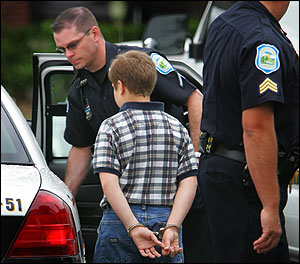
Under SB 56, school administrators have discretion on whether or not to call the police on simple assault but must call the police for aggravated assault, under threat of a fine of several thousand dollars. So if this bill becomes law, that kid gets hauled off by the police, and it doesn't matter if he's 7 or 17. Think for a moment about just how traumatic it would be for a child, any child, to be taken from school in handcuffs.

With administrators having the discretion to report simple assault but being mandated to call the police for aggravated assault, school administrators will be left to determine where particular offenses fit in the criminal code. Third degree institutional vandalism must be reported to the police, under SB 56, but lesser forms of vandalism do not. If you're an administrator and you have a $2500 fine hanging over your head, you're probably going to err on the side of caution and report all forms of vandalism and all forms of assault. Why risk money coming out of your pocket or your school district's pocket?

A problem already exists with schools relying too heavily on police back up to deal with discipline problems. In the 2006-07 school year, law enforcement in Pennsylvania found just 60 percent of incidents reported by schools to be arrest worthy. In other words, police considered 40 percent of the school-based complaints they received to be unworthy of their attention. Schools are calling the police too much, and that's without SB 56 in law.

Ironically, one of the issues coming out of the inter-branch commission on juvenile justice has been that there were too many school-based calls going into police stations in Luzerne County. The excessive use of law enforcement by school officials funneled kids into the juvenile justice system, where two Luzerne judges allegedly took bribes to send kids to detention facilities.

We don't know the future of this legislation. It passed the Senate last year. It has not yet been taken up by the House, but it's possible that there will be a massive (omnibus) bill related to school issues. SB 56 could be in it. It's hard to imagine the Pennsylvania General Assembly doing any worse by our kids.

Andy in Harrisburg

Labels: , ,

Friday, March 26, 2010

The kids are alright. But the adults are screwed up


The 2009-10 legislative session at the PA state capitol is my first full session as ACLU-PA's legislative director. I've been learning a lot and really enjoying the work.

One thing that I've learned is that state legislators really despise our kids. Ok, that's an exaggeration, as I am wont to do in my blogging. I'm sure legislators don't actually despise Pennsylvania's kids.

But based on some of the initiatives that are being pushed at the state capitol, one couldn't help but think that our elected officials have completely forgotten what is was like to be a kid and are not consciously aware of the damage that some of their ideas would do to the commonwealth's children. Consider:

Police in schools. Last year, the Senate passed Senate Bill 56, a bill that mandates public school administrators to call local police when certain offenses occur in school. The original bill was spectacularly draconian, even requiring school administrators to call the police for disorderly conduct and tobacco possession. To the credit of the primary sponsor, Senator Jeffrey Piccola of Dauphin County, some of the most egregious provisions were amended out of the bill.

But the bill is still a raw deal for Pennsylvania's children, especially younger children and kids with disabilities. There are no provisions to give administrators discretion for students' with intellectual disabilities or for younger students. A kindergarten student is held to the same standard as a senior in high school.

Do you think a kindergarten student couldn't be hauled off in handcuffs by the police? SB 56 could make it a more frequent occurrence.

We are hearing rumblings that a massive bill on the public school code will be part of this year's budget and that Senator Piccola is insisting that SB 56 be included in that bill.

Sexting. We all agree that it is a really bad idea for young people to send nude or sexually provocative digital photos of themselves to their partners and friends. A photo like that might never go away.

The answer to this issue, according to Pennsylvania's district attorneys and some legislators, is to arrest the kids, including the kid who willing takes a picture of him- or herself and sends it to a willing participant, e.g. a boyfriend or girlfriend. And here's the best part: Some DAs claim that they are helping these kids. By arresting them.

Sexting is dumb behavior. It's also borne out of growing young people's desires to explore their sexuality, a natural part of being human. And the legislature and DAs in PA think they should be arrested for it.

House Bill 2189 would make all forms of sexting a misdemeanor. The bill passed out of the House Judiciary Committee last week after a failed attempt by Rep. Kate Harper of Montgomery County to further downgrade this "crime" to a summary offense.

Meanwhile, over the last two weeks, legislative chambers in Florida and Illinois have also passed bills on sexting. Bills that made it a summary. Do kids have a friend in Pennsylvania?

Gay foster kids. It's hard to believe that anyone could think it's ok to discriminate against gay foster kids. LGBT foster kids often face abuse, as was well articulated in an op-ed this week by Cei Bell that was published in the Philadelphia Daily News.

In 2007, Rep. Phyllis Mundy of Wilkes Barre introduced a bill that she called a Foster Kids' Bill of Rights. The bill included a non-discrimination provision that included protection for foster kids based on race, color, religion, disability, sexual orientation, national origin, age or gender. When the bill got to the floor of the House, it was amended to water down the non-discrimination provision and essentially make it a suggestion but without the power of law. Why did this happen? Because the Pennsylvania Catholic Conference didn't want the protection for gay foster kids. I kid you not.

What kind of behavior, exactly, does the Catholic Conference want to be able to do to gay foster kids?

So Rep. Mundy has re-introduced the bill as House Bill 2338. The new bill includes the non-discrimination provision but without "sexual orientation." Rep. Mundy went kicking and screaming to the strategy of taking out SO as a protected class, and she gave us the green light to criticize the bill for that omission. Sue Kerr of Pittsburgh Lesbian Correspondents did just that:
They can't pass a bill that protects children from being abused in foster care based on their sexual orientation? I know we are battling mightily to add sexual orientation to non-discrimination laws, hate crimes laws, etc. But this is pretty despicable.

So let's recap: Kids who act out in school, as kids sometimes do, are prone to being hauled down to the police station. Kids who explore their sexuality, as kids sometimes do, are prone to being hauled down to the police station. And gay foster kids can't get protections passed by the state legislature.

The over-criminalization and abuse of our children has got to stop.

Andy in Harrisburg

Labels: , , , ,

Thursday, February 18, 2010

On schools and spy cameras

First, you'll want to have a look at this article on Boing Boing. A brief excerpt:

According to the filings in Blake J Robbins v Lower Merion School District (PA) et al, the laptops issued to high-school students in the well-heeled Philly suburb have webcams that can be covertly activated by the schools' administrators, who have used this facility to spy on students and even their families. The issue came to light when the Robbins's child was disciplined for "improper behavior in his home" and the Vice Principal used a photo taken by the webcam as evidence.

Now, a brief note that I know you'll enjoy. You may remember our two cases involving online student speech, Layshock v Hermitage School District and JS v Blue Mountain School District, in which conflicting rulings were issued simultaneously on February 4 by two different Third Circuit panels. In the Layshock case, one panel ruled unanimously that a school could not discipline a student for online speech created outside of school. In JS, another panel ruled (in a 2-to-1 decision) pretty much the exact opposite. It's a bit baffling.

Now here's the good part: during arguments in the JS case, Judge D. Michael Fisher, who wrote the majority opinion, remarked that "it's not as if there's a fear that schools will begin monitoring student behavior in the home."

I wonder if Judge Fisher reads Boing Boing.

Edit, 2/19/10: By request, here is a link to the complaint in Robbins v Lower Merion School District, the case referenced in the Boing Boing article.

Chris in Philly

Labels: , , ,

Thursday, January 07, 2010

"That's So Gay": Anti-Bullying Legislation and LGBT Teens

As we all recover from the holidays and drag ourselves kicking and screaming back into the swing of things, LGBT advocates in Harrisburg are gearing up to work on several pieces of legislation either currently before the legislature or forecasted to be introduced in the near future. Today's Philadelphia Gay News gives a great summary of some of the high points of these Bills to Watch, which include HB 300 - the antidiscrimination bill we have been blogging about over the course of 2009 - and an anticipated anti-bullying bill.
[N]ew to this year’s legislative docket will be a bill to strengthen statewide anti-bullying protections, which is inclusive of anti-LGBT harassment.

“For the first time ever, this legislation will be introduced to beef up laws to protect against bullying because of sexual orientation or gender identity but also other characteristics, like race, ethnicity and disability,” Kaskey said. “If you look through the statistics on this — 88 percent of LGBT students were victims of verbal abuse, 19 percent were harassed because of their perceived sexual orientation and in just one month, 39 percent of LGBT students skipped class at least once because of safety issues — the need for this is obvious.”

Kaskey said he could not disclose which lawmakers would be leading this initiative, but that it would be introduced this spring.
It should come as no surprise that the use of anti-gay slurs in casual conversation, the harassment of those who are or are perceived to be gay, and the threats of being labeled gay that are used to keep especially boys from stepping outside traditional gender roles are rampant in middle and high schools. It is when we hear the real stories of the kids who have suffered the most from this homophobic culture, however, that the true cost of allowing it to continue becomes apparent. It is hard to imagine that even the staunchest opponent of LGBT rights, if he or she has a modicum of compassion, could fail to be moved by these stories.

If you are a regular reader of Speaking Freely, you will be familiar with one such story - that of C.J. Bills, one of the main characters in the documentary Out in the Silence, which the ACLU of Pennsylvania has been working to bring to communities across the state. In the film, Washington, D.C., resident Joe Wilson decides to publish the announcement of his 2004 Canadian wedding to scientist Dean Hamer in his hometown newspaper, the Oil City (PA) Derrick. The announcement causes a deluge of negative letters to the editor, but Wilson is most interested in a personal letter he receives from Kathy Springer, the mother of a gay teen (C.J.) in Oil City who has been brutally harassed to the point where she had no choice but to withdraw him from school. In response to Springer's plea for help, Wilson and Hamer pack up and go to Oil City. Their film shows Kathy's efforts to get the school board to take action to fix what was happening to her son and the subsequent lawsuit, filed by ACLU of Pennsylvania Legal Director Vic Walczak, when they refused to do so. It also includes emotional testimony by C.J. about what he endured at the hands of his peers and the faculty of the school. (If you are interested in bringing Out in the Silence to your community, please contact Joe Wilson or your local ACLU office.)

Parents who have seen Out in the Silence relate to Kathy and C.J.'s ordeal. Here, one mother describes how, in the absence of resources within her own community, she took her son to PFLAG (Parents, Families, and Friends of Lesbians and Gays) in larger communities to show him that he was not alone.

These stories and others like them illustrate not only the hell that kids are subjected to, but also the lack of resources in small towns for helping families address such situations. (One resource that is available but often not known is the Trevor Hotline, a national suicide prevention hotline for LGBT youth founded as a result of yet another harassed gay teenager who became suicidal as a result of the rejection and harassment he experienced.) At the present time, many schools do not discuss sexual orientation in their anti-bullying policies, and organizations like the ACLU or private lawyers can only take legal action in the small percentage of cases in which the bullying violates another law, such as laws against gender discrimination (if the person is being harassed because he or she does not sufficiently conform to traditional ideas about masculinity and femininity, it falls under the definition of sex discrimination - harassment specifically on the basis of one's sexual orientation does not). This leaves few options for gay teens and their parents when problems occur.

The proposed anti-bullying legislation would provide an important resource to Pennsylvania children and their parents - a written policy at each school that can be used as a basis on which to take action against the offending parties and an authority to complain to (the state Department of Education would be charged with monitoring schools' new policies). Such recourse is a vital addition to the community resources like PFLAG that Joe Wilson and Dean Hamer are trying to promote via screenings of their movie in the rural areas of Pennsylvania and other states, where these organizations are often less active and may not be widely known.

No doubt there will be some who condemn LGBT young people for their "choices" and simply do not care what happens to them - there are always a few. Hopefully, however, most of us, no matter what our other differences may be, can agree that protecting our children from severe harassment and physical assault (all too often to the point where those children consider, attempt, or actually go through with suicide) is both right and urgently necessary.

Becca in Harrisburg

Labels: , , , ,

Thursday, November 12, 2009

"Out in the Silence" Airing Tonight on WPSU

Haven't seen Out in the Silence yet? If you live in the blue areas shown below, you have another chance tonight!


WPSU will be airing the film tonight at 9:00PM.

Go to http://wpsu.org/outinthesilence/airdates_index for announcements of future airdates on public television.

Labels: , , ,

Tuesday, October 20, 2009

Out in the Silence

This month the ACLU of PA has been working to bring "Out in the Silence," a film by Joe Wilson and Dean Hamer, to communities across the state. The film has won several awards (including the Audience Award at the Hardacre Film and Cinema Festival in the small town of Tipton, Iowa, and an Alternative Spirit Award at the Rhode Island International Film Festival), but having seen the film five times over the course of three weeks, I do not need to rely on these recommendations - I am somewhat of an expert myself.

By turns sad, funny, and infuriating, the film follows the lives of several current and former residents of Oil City, PA, a small Rust Belt town in western Pennsylvania. After Joe Wilson, a native of the town, decides to place an announcement of his wedding to Dean Hamer in his hometown newspaper, a flurry of nasty responses ensue. One day, however, he receives a letter from a mother in Oil City whose gay teen has been bullied so badly that she has had to withdraw him from school. Knowing of no other place to turn, she has resorted to writing to a man she just happened to see in the newspaper. Joe and Dean return to Oil City to document what is happening with this mother and her son (see page 16 of the ACLU's 2007 Legal Docket for information about the lawsuit they filed against the school district), as well as Joe's former neighbor and her same-sex partner who are working to open a business in town.

Among the films most notable points are the pain experienced by the teenage C.J., the conversations between filmmaker Joe and an evangelical pastor who wrote a letter to the newspaper condemning his wedding announcement, and the father of a teen in a neighboring community who talks about his transformation from someone who would physically assault gay people just for existing to his support of his son today.

If you have not had the opportunity to see "Out in the Silence" at our screenings in Lewisburg, York, Lititz, Harrisburg, or Titusville, you can watch it on WITF November 1, 2009, at 5:00 p.m. Upcoming showings are also planned for Pittsburgh, Erie, Sharon, Oil City, and Stroudsburg.

Want to bring "Out in the Silence" to your town? Contact the producers and your regional ACLU office for help!

Becca in Harrisburg

Labels: , , , ,

Thursday, February 12, 2009

A Victory for Equality

This past Tuesday, the Waynesboro Area School District’s school board voted to approve a new club – the Gay-Straight Alliance (GSA).

The decision came after hours of public comment, during which many community members quoted Bible verses and expressed concern that the club would be in violation of “God’s law.” A few of the community and board members favoring the GSA responded with more Bible verses, citing concepts such as loving one’s neighbor, not judging, and obeying one’s government.

Regardless of how sincerely held these beliefs are, however, this theological debate was irrelevant to the issue at hand – the right of public school students to form a GSA.

Among the most important founding principles of the United States is religious freedom. The First Amendment to the United States Constitution says, “Congress shall make no law respecting an establishment of religion, or prohibiting the free exercise thereof…” This means that each individual is free to follow whatever religion he or she chooses – or no religion at all – and that the government may not promote one over another. Over the past two hundred years, many religious groups that were persecuted in their home countries came to America because of this freedom. Among these groups were the Quakers, Puritans, Mennonites, Amish, and Catholics. Even today, individuals who have been the victims of religious persecution seek asylum in the United States.

One of the many laws enshrining this right to religious freedom in the United States is the Equal Access Act, which deals with religious freedom as it relates to after-school clubs in public schools. Passed in 1984 with substantial support from Christian organizations seeking to protect student religious groups, the law states that if a school allows any noncurricular group – a student group whose purpose is not directly related to the school’s curriculum – to meet on school grounds during lunch or before or after school, then it may not deny this access to any other noncurricular group. The law also specifically states that a school may not pick and choose between after-school clubs based on the “religious, political, philosophical, or other content of the speech at such meetings.”

Under the Equal Access Act, a school that allows a noncurricular group such as a drama club, chess club, or chapter of Students Against Drunk Driving to meet on school grounds must also allow a Christian Bible study group to meet – and it likewise must permit a GSA. The district may not choose to privilege religious beliefs that view homosexuality as sinful over the beliefs in tolerance, diversity, and the value of love in all its forms that a GSA represents. Even if there are only a few students in the district who want to form a GSA, community members may not “vote” on what religious, philosophical, or moral beliefs these few may follow. The rights of GSAs under the Equal Access Act have been upheld in numerous court cases in Florida, Minnesota, California, and other states.

Many of those who spoke in favor of the new Waynesboro GSA cited the non-religious benefits of such a group. GSAs provide a safe space for lesbian, gay, bisexual, and transgender (LGBT) students. Members provide emotional support to each other and work together to combat the homophobia, discrimination, and harassment that is commonplace in schools. Studies have shown that LGBT youth are regularly subjected to bullying, name-calling, threats, destruction of property, and physical violence at school; that they are more likely than their heterosexual peers to miss school due to fear of harassment; and that they experience higher rates of emotional distress, suicide attempts, and substance abuse as a result of the hatred and prejudice directed at them. Schools with GSAs have reported a decrease in these negative effects of homophobia.

The decision of the Waynesboro school board, therefore, not only obeys the law, it enhances the safety and emotional well-being of every child, regardless of sexual orientation.

Becca in Harrisburg

Resources:

Know Your Rights: A Quick Guide for Lesbian, Gay, Bisexual, and Transgender Students (HTML PDF)
Tips on Starting a GSA
Frequently Asked Questions
Get Help

Labels: , , ,

Friday, July 18, 2008

Friday First Amendment Roundup

A new feature collecting first-amendment related news from around the country. I'm not promising this will happen every Friday, but I'll do my best. And now I'm thinking I should have called it "First Amendment Rodeo!" Oh well. Here we go!!

We start in Philadelphia, where the Third Circuit dismissed a civil suit against the city by Repent America, stemming from the arrest of eleven Repent America members at the 2004 "OutFest" LGBT block party in Center City.

As the Delaware County Times reports, the court ruled that while Repent America had the right to be present at the event (overruling a lower court ruling that the permit issued to event organizers PhillyPride effectively shut Repent America out) but that they crossed a line by intentionally disrupting the permitted event.

World Net Daily, always a fascinating read, offers their own (somewhat slanted) take on the ruling.

***

Frank D. LoMonte has a guest column at the Seattle Post-Intelligencer about attempts to limit the speech rights of public high school students across the country, including some here in Pennsylvania. Not satisfied with being little dictators inside their own walls, some school administrators now want the power to discipline students for their speech outside of school. These are the first few aftershocks of Morse v. Frederick (AKA "Bong Hits 4 Jesus"); where once schools taught their students civics, the lesson now is "sit down, shut up, and do as you're told."

***

On the international stage, the Beijing Olympics are casting a spotlight on many Chinese human rights offenses (including an alleged instruction from Chinese authorities that bars near the Olympic Village are not to admit anyone black or Mongolian) but also on the speech-limiting practices of American corporations (like Google and Microsoft) doing business in China.

The United Nations, meanwhile, is considering a resolution that would criminalize any criticism, parody, or defamation of any religion. Similar laws already stand in many nations - including Canada, where people are sued with some regularity for critical comments or jokes directed at religions. Julia Duin at the Washington Post fears the UN restrictions would be so strict that "anybody anywhere could sue for merely having hurt feelings."

Arlen Specter and Joe Lieberman agree, and took time out to write a piece for the Wall Street Journal saying so. Congress is currently considering three separate bills that would protect Americans from being sued in foreign courts over Constitutionally-protected comments.

***

On the topic of religion and offense, how about that New Yorker cover, huh??

Jayne Lyn Stahl at the Huffington Post casts the rollicking fracas over the cover in the light of history, presenting reflections on free expression and offensiveness from some folks you may have heard of - including Richard Nixon ("the rights of free speech...do not carry with them the right to advocate the destruction of the very government which protects the freedom" - good old Dick!), FDR, and Salmon Rushdie ("What is freedom of expression? Without the freedom to offend, it ceases to exist.")

I especially love that Rushdie quote. After all, speech that offends no one requires no law to protect it. Right?

***

Speaking of offensive speech... The US Court of Appeals for the Armed Forces ruled that a white-supremacist soldier's racist AOL profile was protected by the First Amendment because he did not direct the statements at anyone in particular (a majority of the world's population, sure, but no one in his unit) and "they did not interfere with his job performance or with any military mission," and that he could therefore not be disciplined or discharged because of the profile.

One wonders how an Army paratrooper's job performance is not impaired when he identifies his race as "Aryan," quotes "the imprisoned matyr" [sic] David Lane, and recommends a book in which white Christians kill a mixed-race couple, and when said Army paratrooper's job partly entails making informed decisions about what people he should and should not shoot. One of the five justices did file a dissent.

Still, I guess it's good to see that even if you're enlisted, the Constitution still protects your right to express yourself as a racist jerk.

***

Finally, on the Establishment Front (all quiet since Christmas - right, Bill?) the Texas State Board of Education has approved an elective Bible course to be taught in public high schools. Now, before you go and assume the Board went off half-cocked (a little Texas humor for you, there), read what the Dallas Morning News has to say:
"Among those who urged the board to issue specific guidelines for the class was Rep. Scott Hochberg, D-Houston, who helped write the 2007 law. Mr. Hochberg warned that without specific guidance from the state, some schools would run afoul of the First Amendment requirement of religious neutrality for such classes."
Of course, in the end the majority of the Board voted just to approve "a Bible course" and not to issue any guidelines to tell schools how they should go about teaching it.

"Attorney General Gregg Abbott has told the baord that while the state standards for the Bible class appear to be in compliance with the First Amendment, his office can't guarantee that the courses taught in high schools will be constitutional because they haven't been reviewed.

Critics contend that the board standards for the course are so vague and general that many schools might unknowingly create unconstitutional Bible classes that either promote the religious views of teachers or disparage the religious beliefs of some students."
A Bible class that promotes the religious views of the teachers? In Texas? I don't see what everyone is so worried about. I mean, how often do you hear about teachers pushing their religious views on students?

Sarcasm aside, Texas Board of Education, let me be the first to say: "Thank you for your contribution to the ACLU."

So in conclusion: Texans have never been big on the separation of Church and State. (Sorry, I couldn't resist!)

***

Two small notes:

If you missed the New York Times FISA ad that ACLU ran this week, you can see it here.

And lastly, most of you will (hopefuly) be as happy as me to read that Proposition 8, which would ban same-sex marriage in California, is currently trailing in polls 51 to 42 percent, with less than four months remaining until the vote.


Chris in Philly

Labels: , , , ,

Thursday, April 05, 2007

"You can take care of your cow but you can't take care of your kid"

The Widener Civil Law Clinic, in conjunction with the ACLU of PA and the ACLU Women's Rights Project, filed suit today on behalf of a sixteen year old mother against the Central Dauphin School District in suburban Harrisburg. According to the suit, the school has charged the student with truancy on multiple occasions when she has missed school to tend to her son when he is sick. She and her mother have paid fines, and the student has served a variety of in-school punishments. The Magisterial District Judge threatened to revoke custody of her son if she does not pay the fines and continues to miss school. (Mind you, she's missed some days of school to care of her sick kid.)

We contend that the school has violated her rights under the 14th Amendment (Equal Protection), Title IX, and the Equal Rights Amendment of the PA Constitution.

As a silly sidenote, under Pennsylvania's Compulsory School Attendance Law, "farming" and "agriculture activities" are excused absences. Monica Cliatt, supervising attorney at the Widener Civil Law Clinic, said at today's press conference, "You can take care of your cow but you can't take care of your kid."

You can read our press release here and read the complaint here. The debate has begun over at the Patriot News' website, too.

Litigation is like war- it's the last option. We tried our best to work with the school. Calls and letters went unanswered. According to Cliatt, the best answer we got from one administrator was, "We only talk in court." That's unfortunate.

To be honest, I usually find students' rights cases to be boring. Don't get me wrong. They're important. The Constitution covers people of all ages, not just those over 18. I just find situations where a kid fights over his/her right to wear a t-shirt to be very ho-hum.

But this touches a nerve. Here is a young woman who is in a tough spot. She got herself into a life-altering situation but is now doing everything she can to make the best of it. She is responsibly tending to her child in the present moment and responsibly tending to her education- she's an honor student- with plans to go to college, which will give her and her son a brighter future.

So many teen moms neglect their children or their education or both. And don't get me started about the teen fathers.

Despite our client's best efforts, the school goes after her for truancy and levies detentions, suspensions, etc. An MDJ even has the nerve to threaten to take the child away.

This is government run amok. And that's why, in the words of one local columnist, the ACLU is "an essential institution in a free society."

Andy in Harrisburg

Labels: , ,