Friday, March 26, 2010

The kids are alright. But the adults are screwed up
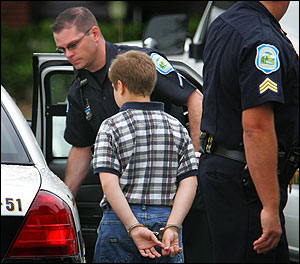

The 2009-10 legislative session at the PA state capitol is my first full session as ACLU-PA's legislative director. I've been learning a lot and really enjoying the work.

One thing that I've learned is that state legislators really despise our kids. Ok, that's an exaggeration, as I am wont to do in my blogging. I'm sure legislators don't actually despise Pennsylvania's kids.

But based on some of the initiatives that are being pushed at the state capitol, one couldn't help but think that our elected officials have completely forgotten what is was like to be a kid and are not consciously aware of the damage that some of their ideas would do to the commonwealth's children. Consider:

Police in schools. Last year, the Senate passed Senate Bill 56, a bill that mandates public school administrators to call local police when certain offenses occur in school. The original bill was spectacularly draconian, even requiring school administrators to call the police for disorderly conduct and tobacco possession. To the credit of the primary sponsor, Senator Jeffrey Piccola of Dauphin County, some of the most egregious provisions were amended out of the bill.

But the bill is still a raw deal for Pennsylvania's children, especially younger children and kids with disabilities. There are no provisions to give administrators discretion for students' with intellectual disabilities or for younger students. A kindergarten student is held to the same standard as a senior in high school.

Do you think a kindergarten student couldn't be hauled off in handcuffs by the police? SB 56 could make it a more frequent occurrence.

We are hearing rumblings that a massive bill on the public school code will be part of this year's budget and that Senator Piccola is insisting that SB 56 be included in that bill.

Sexting. We all agree that it is a really bad idea for young people to send nude or sexually provocative digital photos of themselves to their partners and friends. A photo like that might never go away.

The answer to this issue, according to Pennsylvania's district attorneys and some legislators, is to arrest the kids, including the kid who willing takes a picture of him- or herself and sends it to a willing participant, e.g. a boyfriend or girlfriend. And here's the best part: Some DAs claim that they are helping these kids. By arresting them.

Sexting is dumb behavior. It's also borne out of growing young people's desires to explore their sexuality, a natural part of being human. And the legislature and DAs in PA think they should be arrested for it.

House Bill 2189 would make all forms of sexting a misdemeanor. The bill passed out of the House Judiciary Committee last week after a failed attempt by Rep. Kate Harper of Montgomery County to further downgrade this "crime" to a summary offense.

Meanwhile, over the last two weeks, legislative chambers in Florida and Illinois have also passed bills on sexting. Bills that made it a summary. Do kids have a friend in Pennsylvania?

Gay foster kids. It's hard to believe that anyone could think it's ok to discriminate against gay foster kids. LGBT foster kids often face abuse, as was well articulated in an op-ed this week by Cei Bell that was published in the Philadelphia Daily News.

In 2007, Rep. Phyllis Mundy of Wilkes Barre introduced a bill that she called a Foster Kids' Bill of Rights. The bill included a non-discrimination provision that included protection for foster kids based on race, color, religion, disability, sexual orientation, national origin, age or gender. When the bill got to the floor of the House, it was amended to water down the non-discrimination provision and essentially make it a suggestion but without the power of law. Why did this happen? Because the Pennsylvania Catholic Conference didn't want the protection for gay foster kids. I kid you not.

What kind of behavior, exactly, does the Catholic Conference want to be able to do to gay foster kids?

So Rep. Mundy has re-introduced the bill as House Bill 2338. The new bill includes the non-discrimination provision but without "sexual orientation." Rep. Mundy went kicking and screaming to the strategy of taking out SO as a protected class, and she gave us the green light to criticize the bill for that omission. Sue Kerr of Pittsburgh Lesbian Correspondents did just that:
They can't pass a bill that protects children from being abused in foster care based on their sexual orientation? I know we are battling mightily to add sexual orientation to non-discrimination laws, hate crimes laws, etc. But this is pretty despicable.

So let's recap: Kids who act out in school, as kids sometimes do, are prone to being hauled down to the police station. Kids who explore their sexuality, as kids sometimes do, are prone to being hauled down to the police station. And gay foster kids can't get protections passed by the state legislature.

The over-criminalization and abuse of our children has got to stop.

Andy in Harrisburg

Labels: , , , ,

Wednesday, January 27, 2010

Sexting: A Teen's Thoughts

As a teenaged girl, it seems like guys never get in trouble for anything when it comes to sexual behavior. This is especially true in the recent sexting case that was heard in the U.S. Court of Appeals for the 3rd Circuit. Since we are all supposed to be equal, why are girls the only one’s who get in trouble for sexting? Adults say that sexting is wrong, but in this situation, girls are the ones being charged with a crime and forced to deal with the consequences. If a guy sent around a nude picture of himself, most people would write it off with “boys will be boys”. But if a girl does it, she could be arrested! This makes me wonder: if a guy sends me a nude picture of himself, am I wrong for having that picture in there, even though he is the one who took it? As a young woman I feel this is totally unfair. Guys should be held just as responsible as girls in these situations.

As if the unequal treatment of guys and girls isn’t enough, I also feel this is an invasion of privacy. Cell phones are supposed to be private, so what they are used for should be the owner’s business and no one else’s. What is in my phone is personal and I feel I should be able to have anything I would like to have in there. Although I am not a participant in sexting, I feel it is not as harmful as some adults may think. Everybody should be able to do whatever they want with their own body. My body belongs to me and no one else, so I should be the only one with control over it.

Demia in Philadelphia

Labels: ,

Wednesday, January 20, 2010

Sexting, and What It Means to be a Girl

(Cross-posted with the ACLU's Blog of Rights)

On January 15, the U.S. Court of Appeals for the 3rd Circuit heard arguments in
Miller, et al. v. Skumanick, a child pornography case that, oddly, involves no child pornography. The case goes back to 2006, when two girls aged 12 were photographed by another friend on her digital camera. The two girls were depicted from the waist up, wearing bras. In a separate situation, our third client was photographed as she emerged from the shower, with a towel wrapped around her waist and the upper body exposed. Neither of the photos depicted genitalia or any sexual activity or context. In 2008 the girls' school district learned that these and other photos were circulating, confiscated several students' cell phones, and turned the photos in question over to the Wyoming County district attorney, George Skumanick, Jr.

Skumanick sent a letter to the girls and their parents, offering an ultimatum. They could attend a five-week re-education program of his own design, which included topics like "what it means to be a girl in today's society" and "non-traditional societal and job roles." They would also be placed on probation, subjected to random drug testing, and required to write essays explaining how their actions were wrong. If the girls refused the program, the letter explained, the girls would be charged with felony child pornography, a charge that carries a possible 10-year prison sentence.

Nineteen families received these letters. Sixteen consented to re-education. Three decided their girls would benefit more from a lesson in constitutional law than from Skumanick's views on "what it means to be a girl in today's society,” and called the ACLU of Pennsylvania. In March 2009, a federal judge granted a temporary restraining order preventing Mr. Skumanick and the Wyoming County, Pa., district attorney's office from going ahead with any prosecution. Now it falls to the Court of Appeals to decide whether the DA's office (Skumanick lost his bid for re-election in November) can proceed with prosecution.

This case has branded as the "Sexting Case," and headlines ask questions like "Sexting: Child porn or child's play?" But this case has nothing to do with sex, and nothing to do with pornography. This is a case of a government official using the law to force his personal morals on others. Last February, Skumanick told a group of students and parents that he had the authority to prosecute a girl for being photographed in a bikini on a beach, because the photo was "provocative." In their brief to the 3rd Circuit, the DA's office asserts their opinion that no person could exchange such photographs for any other reason except sexual gratification. Their attorney reasserted this right before the court, stating that a minor's transmission of any photograph of herself containing any nudity is never protected under the First Amendment.

Even if the photographs in question could be construed as pornographic, Skumanick lacked any evidence that the girls had transmitted the photos. His only basis for probable cause, in the words of their attorney, was "the presence of [those] photographs on the cell phones of [their] classmates." It was this lack of probable cause that led to the initial restraining order.

Interestingly, none of the classmates who distributed the photos received letters from Skumanick. Only the girls who appeared in the photos were threatened with child porn charges. If the DA did in fact regard these photos as pornographic, why not file distribution charges against the boys? A clue may be found in their argument before the 3rd Circuit. In narrating the case, their attorney explained how, after the girls were photographed, "high school boys did as high school boys will do, and traded the photos among themselves."

Ultimately, that's what this case comes down to: one man's view on how a young woman should conduct herself. The boys who traded the photos bear no responsibility and require no re-education. Instead the girls are threatened with felony charges and life-long registration as sex offenders. To apply such a penalty, designed to protect minors against exploitation, is a grotesque misapplication - and that's once again assuming that the photographs in question could possibly be construed as pornographic. In reality, there was no way such charges would ever stick, and the DA's office had to know this. The child porn charges were merely a threat, to force the parents to subject their children to Skumanick’s moral view of the world, where any and all child nudity is illegal and bras and bikinis are pornographic.

Instead these parents asserted their constitutional right to dictate the upbringing of their children; their right to say "we don't think this was wrong, and we're not forcing our children to put that in writing, and we're not forcing them to attend your re-education session," without fear of retribution from the DA's office. It is certainly important, in this era of Facebook and Twitter and text messaging, that children learn the consequences of sharing digital photographs of themselves, but as ACLU of Pennsylvania legal director Witold Walczak puts it, "prosecutors should not be using heavy artillery like child-pornography charges to teach that lesson."

The DA’s office argues that the federal court had no place issuing a restraining order, and that the proper procedure would have been to allow the prosecution to go forward and for the girls to mount a constitutional defense against the charges – but the prosecution itself was the threat. The agony of a felony prosecution, of hiring attorneys and mounting a defense, of the media attention surrounding the prosecution of a 16-year-old girl as a child pornographer were, in Walczak’s words, “the Sword of Damacles,” the threat of retribution if these parents refused to turn their children over to Skumanick.

The central question of this case was perhaps best framed by Judge Thomas L. Ambro during 3rd Circuit arguments: "Should we allow the state to force children, by threat of prosecution, to attend a session espousing the views of one particular government official on what it means to be a girl?"

Chris in Philly

Labels: , , ,

Thursday, January 14, 2010

Pass These Bills: A High School Student's View

At a hearing in Harrisburg about two sex education bills, the testimony by witnesses was revealing about the state of education - or miseducation - about sex in our schools. One expert stated the obvious: “Many students are misinformed about sex.” One of the reasons given is that many teachers do not teach about sex because they are uncomfortable talking about it, even though sex is natural and it is nothing to be ashamed of. Another issue is that many teachers are not sufficiently educated on the subject, so they are not qualified to teach it.

HB 1162 and HB 1163 need to be passed so that students have the opportunity to be educated on a subject that really matters in life. These bills will help students to get informed about safe sex, so when they decide to be sexually active they’ll know about more than just abstaining from sex. Abstinence is not the answer for everyone, so by having sex education classes in school, they’ll know about different ways to be safe.

Demia in Philadelphia

Demia Burrell is a junior at Mastery Charter School and will be interning with the ACLU until the end of the school year.

Labels: , ,

Thursday, January 07, 2010

"That's So Gay": Anti-Bullying Legislation and LGBT Teens

As we all recover from the holidays and drag ourselves kicking and screaming back into the swing of things, LGBT advocates in Harrisburg are gearing up to work on several pieces of legislation either currently before the legislature or forecasted to be introduced in the near future. Today's Philadelphia Gay News gives a great summary of some of the high points of these Bills to Watch, which include HB 300 - the antidiscrimination bill we have been blogging about over the course of 2009 - and an anticipated anti-bullying bill.
[N]ew to this year’s legislative docket will be a bill to strengthen statewide anti-bullying protections, which is inclusive of anti-LGBT harassment.

“For the first time ever, this legislation will be introduced to beef up laws to protect against bullying because of sexual orientation or gender identity but also other characteristics, like race, ethnicity and disability,” Kaskey said. “If you look through the statistics on this — 88 percent of LGBT students were victims of verbal abuse, 19 percent were harassed because of their perceived sexual orientation and in just one month, 39 percent of LGBT students skipped class at least once because of safety issues — the need for this is obvious.”

Kaskey said he could not disclose which lawmakers would be leading this initiative, but that it would be introduced this spring.
It should come as no surprise that the use of anti-gay slurs in casual conversation, the harassment of those who are or are perceived to be gay, and the threats of being labeled gay that are used to keep especially boys from stepping outside traditional gender roles are rampant in middle and high schools. It is when we hear the real stories of the kids who have suffered the most from this homophobic culture, however, that the true cost of allowing it to continue becomes apparent. It is hard to imagine that even the staunchest opponent of LGBT rights, if he or she has a modicum of compassion, could fail to be moved by these stories.

If you are a regular reader of Speaking Freely, you will be familiar with one such story - that of C.J. Bills, one of the main characters in the documentary Out in the Silence, which the ACLU of Pennsylvania has been working to bring to communities across the state. In the film, Washington, D.C., resident Joe Wilson decides to publish the announcement of his 2004 Canadian wedding to scientist Dean Hamer in his hometown newspaper, the Oil City (PA) Derrick. The announcement causes a deluge of negative letters to the editor, but Wilson is most interested in a personal letter he receives from Kathy Springer, the mother of a gay teen (C.J.) in Oil City who has been brutally harassed to the point where she had no choice but to withdraw him from school. In response to Springer's plea for help, Wilson and Hamer pack up and go to Oil City. Their film shows Kathy's efforts to get the school board to take action to fix what was happening to her son and the subsequent lawsuit, filed by ACLU of Pennsylvania Legal Director Vic Walczak, when they refused to do so. It also includes emotional testimony by C.J. about what he endured at the hands of his peers and the faculty of the school. (If you are interested in bringing Out in the Silence to your community, please contact Joe Wilson or your local ACLU office.)

Parents who have seen Out in the Silence relate to Kathy and C.J.'s ordeal. Here, one mother describes how, in the absence of resources within her own community, she took her son to PFLAG (Parents, Families, and Friends of Lesbians and Gays) in larger communities to show him that he was not alone.

These stories and others like them illustrate not only the hell that kids are subjected to, but also the lack of resources in small towns for helping families address such situations. (One resource that is available but often not known is the Trevor Hotline, a national suicide prevention hotline for LGBT youth founded as a result of yet another harassed gay teenager who became suicidal as a result of the rejection and harassment he experienced.) At the present time, many schools do not discuss sexual orientation in their anti-bullying policies, and organizations like the ACLU or private lawyers can only take legal action in the small percentage of cases in which the bullying violates another law, such as laws against gender discrimination (if the person is being harassed because he or she does not sufficiently conform to traditional ideas about masculinity and femininity, it falls under the definition of sex discrimination - harassment specifically on the basis of one's sexual orientation does not). This leaves few options for gay teens and their parents when problems occur.

The proposed anti-bullying legislation would provide an important resource to Pennsylvania children and their parents - a written policy at each school that can be used as a basis on which to take action against the offending parties and an authority to complain to (the state Department of Education would be charged with monitoring schools' new policies). Such recourse is a vital addition to the community resources like PFLAG that Joe Wilson and Dean Hamer are trying to promote via screenings of their movie in the rural areas of Pennsylvania and other states, where these organizations are often less active and may not be widely known.

No doubt there will be some who condemn LGBT young people for their "choices" and simply do not care what happens to them - there are always a few. Hopefully, however, most of us, no matter what our other differences may be, can agree that protecting our children from severe harassment and physical assault (all too often to the point where those children consider, attempt, or actually go through with suicide) is both right and urgently necessary.

Becca in Harrisburg

Labels: , , , ,

Tuesday, December 01, 2009

In Focus: The School to Prison Pipeline

The second installment in the Greater Pittsburgh Chapter’s Juvenile Justice Series Discussion focused on the School to Prison Pipeline (STPP).

The School to Prison Pipeline refers to the policies and practices that push our nation’s schoolchildren, especially our most at-risk children, out of classrooms and into the juvenile and criminal justice system. The most important aspect is the prioritization of incarceration over education.

On October 8th, Jasiri X led the discussion at the Amani International Coffee House on the North Side. Jasiri X, an activist and entrepreneur, focuses his attention and celebrity on local, national, and international issues. Weekly, he reports news lyrically over hip hop beats streaming online. Jasiri X is also a founding member of One HOOD, a group comprised of strong black men determined to heal the wounds of the Pittsburgh community through a proactive approach.

The discussion evolved around the reasons why the STPP exists and how it effects the most at-risk youth.

Five main factors contributing to the STPP:

  • Failing Public Schools: Most students’ journeys along the pipeline begin in public schools with inadequate resources-mostly counseling services and special education services that lock students into poor educational environments with no outlets.
  • Zero-Tolerance and Other School Discipline: These polices automatically impose severe punishment regardless of circumstance. As harsh penalties for minor misbehavior become more pervasive, schools increasingly ignore or bypass due process protections for suspensions and expulsions.
  • Policing in School Hallways: Trends toward police acting as disciplinarians and away from teachers and administrators expose students to a rise in school-based arrests, which are the quickest route from the schoolhouse to the jailhouse. School-based arrests exemplify the most apparent exhibit of the criminalization of schoolchildren.
  • Disciplinary Alternative Schools: Many of these institutions are run by for-profit entrepreneurs, who are not accountable for educational standards. When students leave these facilities and reenter their schools, they are often unprepared for their coursework and permanently exposed to an educational disadvantage.
  • Court Involvement and Juvenile Detention: Many youth involved in the juvenile system are denied procedural protections in the courts. Further, their probation conditions are not fitting for the crimes committed. Violating such conditions forces these children into juvenile detention facilities, which provide little to no educational services.

It should be noted that students of color are far more likely to travel through the STPP than their white counterparts for the same conduct. Those with disabilities are also at higher risk because schools do not provide adequate diagnoses or services. Most students who become a part of the STPP never graduate high school.

For more information regarding future Greater Pittsburgh Chapter discussion series, visit http://www.aclupa.org/chapters/greaterpittsburgh/discussionseries20092010.htm.

Kristine in Pittsburgh

Labels: , , ,

Thursday, November 12, 2009

"Out in the Silence" Airing Tonight on WPSU

Haven't seen Out in the Silence yet? If you live in the blue areas shown below, you have another chance tonight!


WPSU will be airing the film tonight at 9:00PM.

Go to http://wpsu.org/outinthesilence/airdates_index for announcements of future airdates on public television.

Labels: , , ,

Tuesday, October 20, 2009

Out in the Silence

This month the ACLU of PA has been working to bring "Out in the Silence," a film by Joe Wilson and Dean Hamer, to communities across the state. The film has won several awards (including the Audience Award at the Hardacre Film and Cinema Festival in the small town of Tipton, Iowa, and an Alternative Spirit Award at the Rhode Island International Film Festival), but having seen the film five times over the course of three weeks, I do not need to rely on these recommendations - I am somewhat of an expert myself.

By turns sad, funny, and infuriating, the film follows the lives of several current and former residents of Oil City, PA, a small Rust Belt town in western Pennsylvania. After Joe Wilson, a native of the town, decides to place an announcement of his wedding to Dean Hamer in his hometown newspaper, a flurry of nasty responses ensue. One day, however, he receives a letter from a mother in Oil City whose gay teen has been bullied so badly that she has had to withdraw him from school. Knowing of no other place to turn, she has resorted to writing to a man she just happened to see in the newspaper. Joe and Dean return to Oil City to document what is happening with this mother and her son (see page 16 of the ACLU's 2007 Legal Docket for information about the lawsuit they filed against the school district), as well as Joe's former neighbor and her same-sex partner who are working to open a business in town.

Among the films most notable points are the pain experienced by the teenage C.J., the conversations between filmmaker Joe and an evangelical pastor who wrote a letter to the newspaper condemning his wedding announcement, and the father of a teen in a neighboring community who talks about his transformation from someone who would physically assault gay people just for existing to his support of his son today.

If you have not had the opportunity to see "Out in the Silence" at our screenings in Lewisburg, York, Lititz, Harrisburg, or Titusville, you can watch it on WITF November 1, 2009, at 5:00 p.m. Upcoming showings are also planned for Pittsburgh, Erie, Sharon, Oil City, and Stroudsburg.

Want to bring "Out in the Silence" to your town? Contact the producers and your regional ACLU office for help!

Becca in Harrisburg

Labels: , , , ,

Wednesday, April 01, 2009

Y-N-T...Youth Need Truth!

Pennsylvanians for Responsible Sex Education (PARSE), a coalition of different organizations, including the ACLU of PA, sponsored a lobby day in Harrisburg yesterday in support of two new bills. The day was a great success as over 100 constituents from all over the state came and met with their legislators to advocate for the bills.

The Healthy Youth Act and the Notice Home Act, are geared towards bettering sex education policy in Pennsylvania. The Healthy Youth Act, which is sponsored by Representative Chelsa Wagner, would require the teaching comprehensive sex education in all public and public charter schools in Pennsylvania. This version of sex education would still include and stress abstinence as the only one hundred percent way to avoid pregnancy or STI contraction, however, it would also provide scientifically accurate, age-appropriate information on forms of contraceptives. The Notice Home Act would require a notice to be sent home to parents in the event that their school teaches or is having an outside instructor come in to teach an abstinence-only program, giving them the opportunity to opt their child out of the instruction. This seems especially important to anyone who has seen the antics of many of these “abstinence educators” like Derek the Clown. This bill is sponsored by former teacher, Representative Ed Pashinski.

A rally was held in the rotunda of the capitol building in Harrisburg, featuring several speakers including Jordyn Bowen, a Union City High School student who is for comprehensive sex education. Fun was had and some positive change was hopefully made! Thanks to all of those involved!

Check out a video that was taken of the event as well as a radio interview of another student.


Cassidy in Philadelphia

Labels: , , ,

Thursday, February 12, 2009

A Victory for Equality

This past Tuesday, the Waynesboro Area School District’s school board voted to approve a new club – the Gay-Straight Alliance (GSA).

The decision came after hours of public comment, during which many community members quoted Bible verses and expressed concern that the club would be in violation of “God’s law.” A few of the community and board members favoring the GSA responded with more Bible verses, citing concepts such as loving one’s neighbor, not judging, and obeying one’s government.

Regardless of how sincerely held these beliefs are, however, this theological debate was irrelevant to the issue at hand – the right of public school students to form a GSA.

Among the most important founding principles of the United States is religious freedom. The First Amendment to the United States Constitution says, “Congress shall make no law respecting an establishment of religion, or prohibiting the free exercise thereof…” This means that each individual is free to follow whatever religion he or she chooses – or no religion at all – and that the government may not promote one over another. Over the past two hundred years, many religious groups that were persecuted in their home countries came to America because of this freedom. Among these groups were the Quakers, Puritans, Mennonites, Amish, and Catholics. Even today, individuals who have been the victims of religious persecution seek asylum in the United States.

One of the many laws enshrining this right to religious freedom in the United States is the Equal Access Act, which deals with religious freedom as it relates to after-school clubs in public schools. Passed in 1984 with substantial support from Christian organizations seeking to protect student religious groups, the law states that if a school allows any noncurricular group – a student group whose purpose is not directly related to the school’s curriculum – to meet on school grounds during lunch or before or after school, then it may not deny this access to any other noncurricular group. The law also specifically states that a school may not pick and choose between after-school clubs based on the “religious, political, philosophical, or other content of the speech at such meetings.”

Under the Equal Access Act, a school that allows a noncurricular group such as a drama club, chess club, or chapter of Students Against Drunk Driving to meet on school grounds must also allow a Christian Bible study group to meet – and it likewise must permit a GSA. The district may not choose to privilege religious beliefs that view homosexuality as sinful over the beliefs in tolerance, diversity, and the value of love in all its forms that a GSA represents. Even if there are only a few students in the district who want to form a GSA, community members may not “vote” on what religious, philosophical, or moral beliefs these few may follow. The rights of GSAs under the Equal Access Act have been upheld in numerous court cases in Florida, Minnesota, California, and other states.

Many of those who spoke in favor of the new Waynesboro GSA cited the non-religious benefits of such a group. GSAs provide a safe space for lesbian, gay, bisexual, and transgender (LGBT) students. Members provide emotional support to each other and work together to combat the homophobia, discrimination, and harassment that is commonplace in schools. Studies have shown that LGBT youth are regularly subjected to bullying, name-calling, threats, destruction of property, and physical violence at school; that they are more likely than their heterosexual peers to miss school due to fear of harassment; and that they experience higher rates of emotional distress, suicide attempts, and substance abuse as a result of the hatred and prejudice directed at them. Schools with GSAs have reported a decrease in these negative effects of homophobia.

The decision of the Waynesboro school board, therefore, not only obeys the law, it enhances the safety and emotional well-being of every child, regardless of sexual orientation.

Becca in Harrisburg

Resources:

Know Your Rights: A Quick Guide for Lesbian, Gay, Bisexual, and Transgender Students (HTML PDF)
Tips on Starting a GSA
Frequently Asked Questions
Get Help

Labels: , , ,

Tuesday, January 13, 2009

Virginity Pledges: A Waste of Time and Money

Well surprise, surprise. Teens who take “virginity pledges,” (signed documents stating that they will wait until marriage before engaging in sexual activity) are not less likely to have sex than their peers according to a recent study conducted by Janet Elise Rosenbaum of Johns Hopkins University. (CNN.com “Virginity Pledges don’t Mean Much, Study Says”)

Pledge is an interesting word. It is defined by Merriam-Webster’s dictionary as “a binding promise or agreement to do or forebear.” Okay. Now let’s look closely at that definition so that it can be understood a little better. Promise and agreement are too pretty simple words, so I think those are understood. But what about binding? Webster’s went with “to exert a restraining or compelling affect.” Okay. What really makes something binding though? A piece of paper with a signature? If that were true there would be much more trust in regards to our local and federal governments. I mean, c’mon, how many signed “agreements” have been broken when the parties involved became less interested? Just take one look at our lame-duck President George W. Bush and his trail of broken promises or “agreements” because he had “executive power.” No, a signature on a piece of paper is not binding. What makes something binding is the ability of some group or person to enforce the signer’s agreement. This is true of legal documents (well most anyway.) It is this reason that virginity pledges just don’t work. There is nothing forcing these teenagers to follow through with their pledge in the face of love or even just lust. That is, unless their parents or clergy find out and, even then, it still is not binding. They won’t go to jail or be fined for breaking their promise…at least not yet.

So sex is forced to be secret, to be a shameful act, or one of delicious rebellion, depending on the kid. This need for secrecy is what makes policies like virginity pledges so dangerous. It is yet another barrier put up to stop teens from finding out about healthy sexual behaviors and the risks that are involved in unprotected sex. After hearing your Mom tell you how “truly proud!” she is of you for signing a virginity pledge, are you really going to feel like fessing up? “Oops!” probably won’t cut it. So you probably don’t tell, but you keep having sex. The problem here is schools that participate in virginity pledges probably only teach abstinence. Sex is off topic in home and at school, so knowledge on the subject comes from friends who have probably not discussed sexual health with an honest, knowledgeable adult. This is the reason why teens who take virginity pledges have sex as much as their peers but are much less likely to use a condom or contraceptives.

To make it even more obvious how ridiculous the use of virginity pledges are in light of the fact that they don’t work, is they are yet another example of wasted funds allotted for education. Pledges don’t work, plain and simple. Their usefulness is not being debated based on ideology alone, but rather, simple effectiveness. In a country that prides itself on creating effective systems and programs, virginity pledges should be erased due to their failure to produce results. That is not an ideological point of view; it is a logical one.

Cassidy in Philadelphia

http://www.cnn.com/2008/HEALTH/12/30/virginity.pledges/

Labels: , ,

Thursday, August 14, 2008

No condom = trust and commitment?

And so ends the What's the New What segment, "Sex Without Condoms is the New Engagement Ring", aired July 24th:
"I'm sure you have something to say about Pendarvis' new What. Don't be shy. Get it all out by e-mailing us"

And oh, oh boy, how the responses flooded discussion boards and blogs across the web.

The segment, which features Youth Radio's Pendarvis Harshaw, discusses how some youth who find themselves in committed, monogamous relationships are intentionally having sex without condoms after being clinically screened for sexually transmitted diseases and infections (including HIV)and receiving a negative from both partners.

NPR Listeners
did NOT want to hear this. They threatened to revoke their NPR contributions and even their listenership, and commented:
"I am absolutely disgusted by your program"

"Pendarvis Harshaw's essay should be on the WTF program."

Some argue that these youth are acting irresponsibly by intentionally engaging in unprotected sex while others argue that actually having conversations about sex and behavior and even taking the step to be tested is responsible behavior.

RH Reality check picked up and reports on the controversy (the segment on What's the New What begins at 16:15--I apologize for not editing) and discusses the piece's significance with its creator. Amanda Marcotte points out that this piece brings into question HOW we address youth and how we interact with youth.

Apparently, youths' choices are overshadowed with how every and anyone else thinks youth should be behaving. Well, if we are unwilling to even hear the reality of the experience of youth, how can we expect to connect with them or teach them about anything, including safer sex?

Additionally, if listeners are so opposed to youth sharing their stories (about sex) and realities (about sex) with other youth, going as far to say that NPR should not tolerate stories such as Harshaw's and should not broadcast it, what forms of censorship are they imposing?

The controversy does not stop here, however. Oh, no. The author's style, speech patterns and music choices are all brought into question. I wonder how the piece would have been received if any one of these factors were altered, even slightly. Many of these factors, including thoughts on race, class, gender and sexuality are all addressed through blogs such as feministing.com (where I originally found the piece), jezebel and boinboing.

Ellen at Duvall

Labels: , , , ,